

AI antibody discovery uses computational models to represent, prioritize, optimize or generate antibody candidates. The output is a hypothesis, not a validated antibody. A credible workflow connects selected sequences to experimental production, analytical QC and fit-for-purpose binding, stability, specificity or functional testing, then returns structured results to the next design decision.12
I’m Julia Pizzolato, PhD, Commercial Scientific Liaison at evitria in Zurich. My background spans protein engineering, antibody design, data science and biomanufacturing analytics, and I support customers and project teams through technical consultation, feasibility assessments and training.
In this article, I talk about AI-generated and -optimized sequences from model to experiment. The scope is discovery and preclinical work, so clinical AI and GMP process control are not covered here.
Throughout, “AI” means machine-learning (ML) models trained on data, “HTP” is high-throughput production and “HTS” is high-throughput screening. “CHO” stands for Chinese hamster ovary cells. “De novo design” means designing a binder without starting from an antibody that already binds the epitope3. “Developability” covers the biophysical properties, such as stability and aggregation, that decide whether a binder can become a drug2.
What is AI antibody discovery?
AI antibody discovery applies machine learning to antibody sequences, structures and measured properties so a team can decide which candidates to make and test next1. A model learns how sequence and structure relate to properties such as affinity, specificity, stability or manufacturability, then ranks, modifies or proposes sequences accordingly1.
Definition: AI antibody discovery is the use of machine learning to represent antibody sequences and structures, relate them to measured properties, and prioritize, optimize or generate candidates for experimental testing.
The output of the model is a score or a prediction, which is only a hypothesis about a physical molecule. AI therefore narrows or reshapes the search that conventional antibody discovery runs by immunization, library screening or isolation from patients3.
AI output = hypothesis, not validated antibody.
Which model class fits depends on the decision it has to inform.
Where can AI support antibody discovery?
AI can support five types of discovery decisions, but every output comes with a question: what do you need to measure before believing it?
| Discovery question | What a model may contribute | Output | What it does not prove | Next evidence |
|---|---|---|---|---|
| How is the antibody described to a model? | Features from sequence and structure1 that can be fed back into the model | Embeddings | That the features carry the property you need | Held-out sequences with measurements |
| What might the binding mode be? | A predicted structure or complex1 | Structural hypothesis | That it binds, or binds that way | Binding data; structure if the pose is the claim |
| Which candidates to test first? | Ranking by predicted affinity or other parameters1 | Ranked list | Measured affinity or specificity (in case of binding) | Binding data, against a baseline (in case of binding) |
| Find new sequences whose antibody might bind to a target. | Generated variants or CDRs13 | Proposed sequences | That they express, bind or work in the intended format | Expression, purification, binding tests |
| Which candidates will behave well? | Predicted stability, viscosity or expression1 | Property scores | Behavior of the purified protein | Developability measurements |
No single model covers all five rows2, and the last two columns state what each output still has to prove.
What AI cannot establish from sequence or score alone
A sequence or a score cannot tell you how the protein behaves once it exists. The left column below is what a model can hand you; the right is what only an experiment can establish23.
| A model can propose | Only an experiment can establish |
|---|---|
| A sequence to make | Expression and purification behavior |
| A binding hypothesis | Measured binding and kinetics |
| A selectivity prediction | Specificity against off-targets |
| A stability or aggregation score | Physical stability and aggregation |
| A plausible mechanism or ranked shortlist | Functional performance and therapeutic suitability |
The RFdiffusion study shows the gap from the design side: VHH success rates ranged from 0% to 2% depending on the target3. Which tests you need depends on intended use, target, format and development stage, and on the type of output a model gives you.
Which AI models are used in antibody discovery?
Sequence, structure and property models answer different discovery questions, so model choice should follow the decision and the data you have2. Sequence-based models, including protein language models, learn from antibody sequences, whereas structure-based models predict or design three-dimensional structure and binding. Property models estimate traits such as stability or viscosity, generative models propose new sequences, and hybrids combine these approaches1. To compare antibody discovery model classes, look at the output each produces and the experiment it needs next.
What is de novo antibody design?
De novo antibody design proposes a binder for a chosen epitope without starting from an antibody that already binds it3. That separates it from affinity maturation, which improves a known binder, and from optimization, which changes selected properties of an existing molecule13.
Even so, a design is not a measured binder: As an example, also in the reported RFdiffusion VHH and scFv work, they depended on experimental screening and structural checks and their results are valid only for the targets and formats tested3. The journey from design to measurement is mapped below.
What does an AI-assisted antibody discovery workflow look like?
An AI-assisted workflow is an illustrative loop of ten steps, from objective to next-round decision, with experiments on both sides of the model and three gates where you proceed, revise the panel or stop.
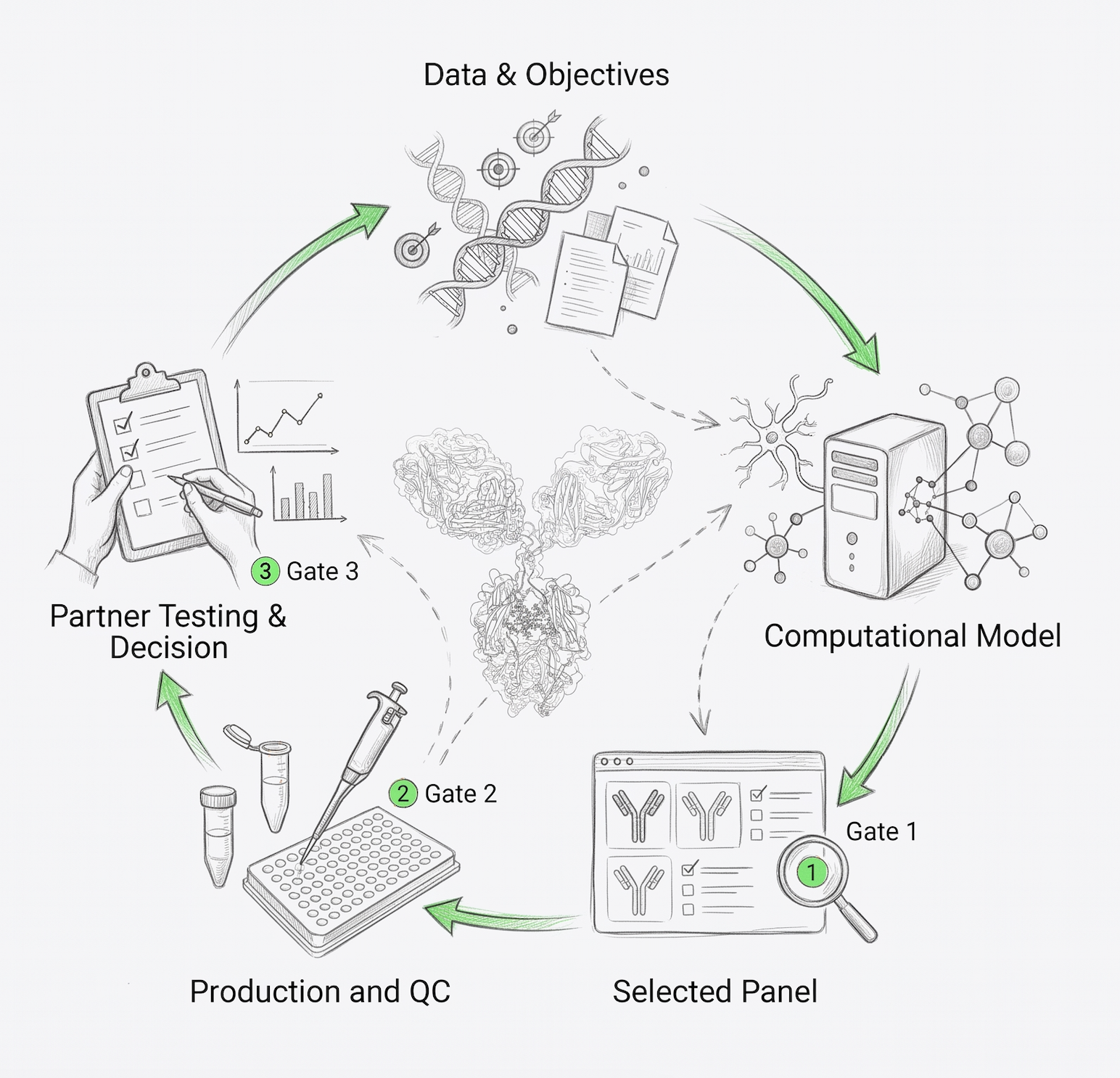
- Define the objective and acceptance criteria.
- Assemble task-relevant data with its context.
- Train, select or apply a model, with validation splits that match the intended use4.
- Generate or prioritize sequences.
- Select a bounded panel. Gate 1: is the panel testable, with controls defined?
- Synthesize or clone and express the antibodies.
- Purify and run analytical QC. Gate 2: does the material meet the agreed QC criteria?
- Run fit-for-purpose internal or external assays.
- Compare against controls and baselines. Gate 3: do the results meet the criteria from step 1?
- Return structured results to the next design round into step number 3 or the lead decision.
Matsunaga and Tsumoto describe the same loop: teams produce the predicted antibodies, validate them in assays and can feed the results back into the model. The guide to the physical validation of AI-designed antibodies covers steps 6 and 7. Once a model ranks these hypothetical sequences, the challenge shifts from the digital to the physical. This is where high-throughput production (HTP) enters the loop.
Where do HTP and HTS enter the loop?
HTP is the production layer (steps 6 and 7) and HTS the testing layer (steps 8 and 9). QC is important to ensure the quality of the protein and the suitability for downstream assays, yet production alone is not a binding or functional screen.
| HTP | HTS | |
|---|---|---|
| What it is | Parallel expression and purification | Testing of the produced variants |
| Output | Purified, QC-characterized material | Binding, specificity or functional readouts |
| Question it answers | Can each sequence be made, and is the material pure and comparable? | Does the protein do what the program needs? |
When reviewing AI-generated panels, I rely on four general habits to keep the physical proteins comparable.
- Screen in silico first. Before you express de novo designed proteins, run a first in silico screen for chemical liabilities and other expression issues.
- Freeze the format. Change only the variable domains and keep everything else constant, so results stay comparable across constructs.
- Pilot, then scale. Express just enough in the first run for the most important initial tests, then scale up for larger experiments on a few lead candidates.
- Keep the negative data. If the results will feed back into a model, also express some sequences you expect to perform less well, record all metadata and link every result to its construct ID automatically, for example by barcoding.
What did the AIntibody benchmark show?
AIntibody, a prospective and blinded benchmark, showed that AI can optimize antibodies in defined, data-rich settings, yet the successes did not transfer reliably across tasks2. It collected 511 antibody sequence submissions from 29 organizations on three tasks: in silico affinity maturation, affinity ranking within clusters of related heavy-chain CDR3 sequences, and design of CDRs outside the selection output. Independent laboratories tested every design under uniform protocols2.
The chosen target was favorable: the SARS-CoV-2 receptor-binding domain, one of the best-characterized proteins, with unusually rich sequencing data. The authors read the results as an upper bound for that target class, not as performance on arbitrary antigens2.
| Task and data regime | Reported result pattern | Baseline | Practical lesson | Limitation |
|---|---|---|---|---|
| Affinity maturation, from phase 1 sequencing output | About 13% of submissions improved affinity 20-fold or more2 | Consensus of the selection data, no ML: ranked third2 | Clearest success case | Uneven: eight participants produced no developable binder2 |
| Affinity ranking in HCDR3 clusters | Only 9.8–13.8% of submissions beat the cluster control2 | Random clones: 39% beat it2 | Finding binders is easier than ranking affinity | All but one strategy fell below random picking2 |
| CDR design outside the selection output | Highly variable: 9.5% of submissions below 100 pM, 46.4% nonbinders or not developable2 | Standard selections, often not beaten2 | Design beyond the library can work, but unreliably | The winning antibody had flaws that would probably have excluded it clinically2 |
| All three tasks | Winning methods varied by task and rarely transferred2 | Task-specific | Match method to task and data | One target, rich data2 |
Affinity maturation is the result I would explain first to a preclinical team. Several groups produced developable antibodies below 100 pM across the three tasks, though the authors call these successes exceptions that did not transfer2. In affinity maturation, one AI design at 94.7 pM was statistically tied with the best experimental antibody at 113 pM2. I read this as evidence that AI already helps with optimization in experimentally informed sequence landscapes, yet reliable affinity ranking and design beyond the library remain much harder23. That gap is why AI designs need experimental testing.
Even with a strong result the question remains: what would a far simpler method have delivered?
Why simple baselines still matter
A simple baseline can beat a sophisticated model, so trust a model only against a credible baseline for the same task. In affinity maturation, a statistical consensus of the selection data ranked third, ahead of most AI designs. In cluster ranking, random picks beat nearly every AI strategy: 39% improved on the cluster control, against 9.8–13.8% of AI submissions2. But neither result shows that simple methods always win.
Compare the model with a credible baseline. Baselines depend on the data behind each task, so the next question is what makes antibody data usable for a model.
What makes antibody data AI-ready?
AI-ready antibody data link each sequence to a measurement and to the context that produced it. Because every label depends on the assay and the biological context1, an affinity number is hard to reuse without the linked fields below. Combining datasets across contexts creates data hazards once that context disappears5, and even good data do not guarantee generalization2, so documented data and sound validation splits belong to reliable ML engineering4.
| Linked field | What it settles for the next model decision |
|---|---|
| Sequence and chain pairing | Which molecule the label belongs to |
| Construct and format | Whether two results describe the same molecule |
| Host and process | Whether expression behavior is comparable |
| QC result | Whether the sample was what you think it was |
| Assay and conditions | What the number means |
| Provenance: sample ID, date, batch | Whether results can be traced and joined |
Before anyone trains on joined production and assay data, I would run a few general checks, starting with the controls: are they still present, and are their values where they belong? Row counts come next, to confirm that every expected row is present, then the “no value” entries, because it matters whether the assay failed or was never performed. I would also separate technical re-reads from biological replicates and look for saturated wells, which can truncate the top performers.
The note on data integrity in AI antibody discovery adds the production view. Sound data feed the model; the next task runs the other way, turning its shortlist into a testable panel.
What makes a candidate ready for experimental comparison?
A candidate is ready for experimental comparison when you can say what you will make, how you will compare it and who will test it. Treat the checklist below as a project aid, not a universal standard.
- Sequence and chain pairing confirmed.
- Format and controls defined, the same for every construct.
- Panel size bounded by the decision it supports.
- Expression host selected for the question you want answered.
- Acceptance criteria and downstream tests agreed before production starts.
- Sample identifiers assigned, so every result maps to one design.
- Data handoff specified: what comes back, in which format, and to whom.
When does CHO-based expression add relevant context?
CHO-based expression adds relevant context when the decision concerns expression or product behavior in CHO, or when you expect later production in CHO. The comparison of HEK293 and CHO for HTP expression sets out how hosts differ in glycosylation and folding fidelity, which can change stability and aggregation behavior.
Host relevance depends on the intended question. Do not generalize: a CHO result does not remove translation risk or prove scale-up, and not every AI workflow needs CHO.
Whichever host you choose, its material is only the first rung of evidence; the next section lines up the others.
Which evidence should guide lead decisions?
No single score establishes therapeutic suitability, so lead decisions rest on a ladder of evidence: each rung answers one question and leaves another open.
| Evidence type | Question answered | Question still open | Typical owner |
|---|---|---|---|
| Computational score | Which candidates look promising to the model | Whether any can be made, bind or work | Computational team |
| Expression result | Whether the sequence can be produced in the chosen host | Whether it binds or is stable | Production lab |
| Purification and analytical QC | What was made: purity, concentration, endotoxin, aggregation | Whether it binds or functions | Production lab |
| Binding and specificity | Whether it binds the target, and how tightly and selectively | Whether it behaves well or works in cells | Your team or partner |
| Physical-property profile | Stability, aggregation, polyreactivity | Whether it works functionally | Your team or partner |
| Functional test | Whether it does what the program needs | Whether it suits the therapeutic use | Your team or partner |
AIntibody judged every submission by measured affinity and a five-assay developability panel2, but that panel is the study’s design, not a standard: the right assays depend on target, format and intended use. The overview of developability readouts covers the properties worth checking. The ladder also explains why screening-scale expression cannot answer yield questions.
Can AI optimize antibody production yield and scale-up?
Not by itself. AI can support the prioritization of sequences in defined settings1, but a better screening-scale expression result does not establish optimized process yield or successful scale-up. Sequence ranking, screening-scale expression and later process development answer different questions, as the comparison of HTP and preclinical-scale production explains. Yield sits at the far end of a longer path, which leads to the wider lifecycle.
Where does AI antibody discovery fit in drug development and biopharma?
Antibody discovery is only the first stage of a longer path. Reviews map AI uses across drug discovery, development and clinical trials6, and the decision an AI output informs changes at every stage. A ranking that tells a lab which experiment to run next needs different evidence than a call that affects a patient or a production batch. Our guide to AI in drug development follows that lifecycle from discovery through clinical development and postmarketing to manufacturing. It shows which evidence each use needs and who owns the decision, with antibody discovery as the worked example. This article stays with discovery and the preclinical material needed to test it. Within discovery itself, one Nature study asks whether AI can do more than answer isolated questions7.

What is agentic AI in antibody discovery?
In the Virtual Lab study, agentic AI means a team of large language model (LLM) agents working on an open-ended research problem instead of answering one question at a time, while a human researcher gives high-level feedback7. A principal investigator agent led scientist agents through research meetings, and together they created a nanobody design pipeline that incorporates the protein language model ESM, AlphaFold-Multimer and Rosetta. The agents designed 92 nanobodies against recent SARS-CoV-2 variants. Experimental validation found a range of functional nanobodies, and two showed improved binding to JN.1 or KP.3 while keeping strong binding to the ancestral spike protein7.
This is one study, on one target family, with a human in the loop, and 92 designs are not 92 validated therapeutics. Nothing in the abstract shows that the approach carries over to other antigens, formats or hosts. Generalist biological AI, which spans DNA, RNA, proteins and cells, is a related direction that counts improved AI agents among its opportunities8.
I read the result as evidence that agents can propose testable candidates, and as a reminder that agent-designed sequences climb the same evidence ladder as any other.
Whoever proposes the candidate, one question remains: how do you judge a workflow before committing material to it?
How should teams evaluate an AI antibody workflow?
I would put ten questions to any AI antibody program, starting from the decision it supports.
- Intended use: which decision, for which target and format?
- Data regime: what did the model learn from, and how close is that to your target?
- Baseline: which simple method must it beat?
- Uncertainty: does it report how sure it is4?
- Prospective evidence: did anyone test it on unseen sequences, ideally blinded2?
- Panel design: how many sequences, which controls, and why?
- Production and QC plan: what do you make, in which host, and what do you measure?
- Downstream ownership: who runs the binding, specificity and functional tests?
- Data return: how do results, failures included, return to the next round?
- Go/no-go criteria: which result advances, redesigns or stops each candidate?
Where does evitria fit?
At evitria, we support the physical production and analytical QC stage for selected AI-prioritized or AI-designed sequences. You send us the sequences your team has chosen, and we express them by CHO-based transient expression; our high-throughput antibody expression service runs panels of up to several hundred constructs in parallel. We then purify each construct and run analytical QC, so your downstream tests start from characterized material.
Standard analytics cover antibody purity, quantification, concentration and endotoxin level, with endotoxin below 1 EU/mg. Delivery from sequence takes as little as four weeks, depending on the project.
Parallel CHO-based transient expression can provide material for comparative downstream testing, which gives an AI design the measured data it needs. The appropriate host, panel size and test plan depend on your program’s intended question, and binding, specificity and functional assays stay with your team and your partners. Our services cover research and preclinical work in therapeutics development.
Key takeaways
- AI narrows or reshapes the search, but every model output stays a hypothesis until binding, specificity and function are measured on comparable, QC-checked material.
- AIntibody found task-specific successes, clearest in affinity maturation, on one well-characterized target, and most cluster-ranking strategies fell below random picking.
- evitria expresses and purifies client-supplied sequences by CHO-based transient expression, with analytical QC, for research and preclinical work.
FAQs about AI antibody discovery
AI antibody discovery is the use of computational models to represent, prioritize, optimize or generate antibody candidates1. The output is a hypothesis, and it becomes evidence only after you express the selected sequences, check them by analytical QC and test them for binding, specificity, stability or function.
In defined workflows, yes: AI can propose candidates. In the RFdiffusion study, the authors experimentally confirmed designed VHHs and scFvs that engage chosen epitopes, although VHH success rates ranged from 0% to 2% depending on the target3. “Designed” still does not mean validated, so a design stays a candidate until measured binding, specificity and developability say otherwise.
Current evidence does not support a universal replacement. In the AIntibody benchmark, affinity maturation was a clearer success case, yet most cluster-ranking strategies did not beat random clone picking and results did not transfer across tasks2. AI can narrow what you test, but the laboratory still decides what advances.
The tests depend on intended use, target, format and development stage. They typically start with expression, purification and analytical QC, such as purity, concentration, aggregation state and endotoxin, and continue with fit-for-purpose binding, specificity, stability or functional tests, plus developability measurements where the program needs them24.
HTP produces; HTS measures. High-throughput production expresses and purifies many antibody variants in parallel, whereas high-throughput screening tests them in assays, so production alone is not a binding or functional screen.
We express and purify selected sequences by CHO-based transient expression and provide analytical QC, so your downstream tests start from measured material. Downstream assays and model work stay with your team and your assay partners.
References
- Matsunaga R, Tsumoto K. Accelerating antibody discovery and optimization with high-throughput experimentation and machine learning. J Biomed Sci 32, (2025) 46. https://doi.org/10.1186/s12929-025-01141-x ↩︎
- Erasmus MF, Bedinger D, Hopkins E, et al. A blinded, prospective benchmark of in silico antibody discovery anchored to experimental affinity and developability. Nat Biotechnol (2026). https://doi.org/10.1038/s41587-026-03238-6 ↩︎
- Bennett NR, Watson JL, Ragotte RJ, et al. Atomically accurate de novo design of antibodies with RFdiffusion. Nature 649, (2026) 183-193. https://doi.org/10.1038/s41586-025-09721-5 ↩︎
- Herrera-Rocha F, et al. Best Practices for Machine Learning-Assisted Protein Engineering. J Chem Inf Model 65(23), (2025) 12655-12667. https://doi.org/10.1021/acs.jcim.5c01983 ↩︎
- Zelenka NR, et al. Data hazards in synthetic biology. Synth Biol 9(1), (2024) ysae010. https://doi.org/10.1093/synbio/ysae010 ↩︎
- Zhang Y, Mastouri M, Zhang Y. Accelerating drug discovery, development, and clinical trials by artificial intelligence. Med 5(9), (2024) 1050-1070. https://doi.org/10.1016/j.medj.2024.07.026 ↩︎
- Swanson K, Wu W, Bulaong NL, et al. The Virtual Lab of AI agents designs new SARS-CoV-2 nanobodies. Nature 646, (2025) 716-723. https://doi.org/10.1038/s41586-025-09442-9 ↩︎
- Rao VM, Zhang S, Plosky BS, et al. Generalist biological artificial intelligence in modeling the language of life. Nat Biotechnol 44(6), (2026) 918-933. https://doi.org/10.1038/s41587-026-03064-w ↩︎