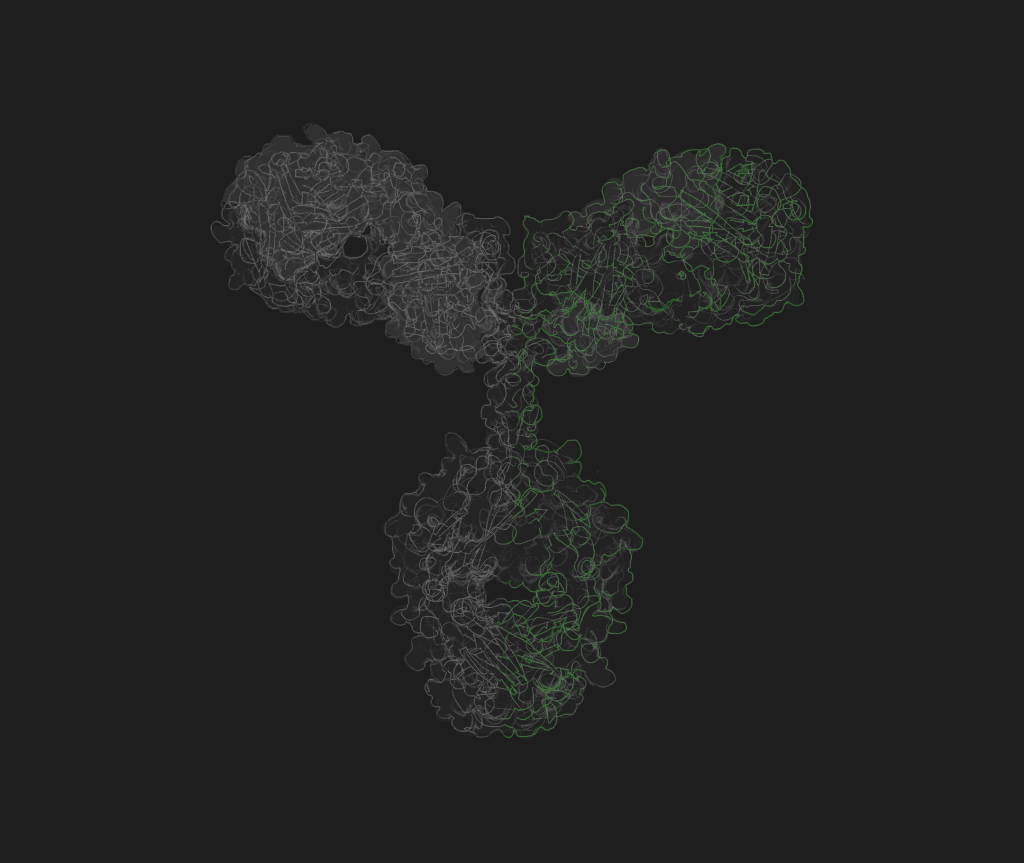
evitria’s bispecific antibody production service delivers research-ready bispecific antibodies (bsAbs) from transient CHO expression in as little as 4 weeks.
Bispecific antibody production service, from Switzerland to the world
evitria’s bispecific antibody production service expresses research-ready bispecific antibodies in transient CHO cells, across all major formats from DuoBody® and knobs-into-holes to IgG-scFv.
We optimize chain pairing and polishing conditions for high heterodimer purity, apply Opti-mAb® stabilization to demanding scFv constructs, and deliver microgram to gram quantities in as little as 4 weeks.
In need of a reliable bispecific antibody production service that ensures proper assembly of constructs? We support the expression of all common bispecific antibody types, including DuoBody® System (Genmab), IgG-scFvs, Knobs-into-Holes, CrossMab, Electrostatic Steering, Disulfide bridge engineering and other related formats. For every project, we optimize chain pairing to deliver high heterodimer purity, confirmed by LC-MS analysis.
Unsure of what format of bispecific antibody you should use in your research? We are happy to guide the design of your constructs – come to us with mAbs and leave with bsAbs through our bispecific screening program.
Charge-complementary interface mutations favour the heterodimer
Heterodimer enrichment
Asymmetric formats for both HC/HC and HC/LC pairing
IgG-scFv
2+2
scFv fused to each heavy-chain C-terminus (or on another end) via a flexible linker
SEC polishing for high purity
Higher valency, flexible design
Tandem scFv (BiTE-like)
1+1
Linked scFvs, no Fc region
Size-based polishing
Compact T-cell engagers
VHH-based
varies
Single-domain building blocks linked to each target
Format-dependent
Compact multispecifics
Improved selectivity & reduced side effects with our bispecific antibody production service
Bispecific antibodies (bsAbs) can be categorized by their activity or by their structural format. By way of activity, trans co-engagers interact with two different epitopes on two different cells, for instance, bringing a T-cell into close proximity with a tumor cell and activating cytotoxic pathways for cell destruction (Figure 1). Cis co-engagers interact with two different antigens on the same cell, thereby improving the selectivity of the antibody and reducing therapeutic side effects.1
At evitria, we are happy to support our customers not only with our high-quality bispecific antibody production service, but we can also help you to identify the ideal bsAb type for your project with our screening options.
Our bispecific antibody production service – structure and formats
Structurally, antibodies can be categorized based on the number of antigen binding domains they possess (their valency), and how they are divided between the different targets. For instance, bispecific antibodies are often classified as “1 + 1” (two binding sites, one for each target), “2 + 2” (four binding sites, two for each target), or “2+1” (three binding sites, two for one target, one for the other). Further combinations are possible, and more targets can be engaged using multi-specific antibodies.
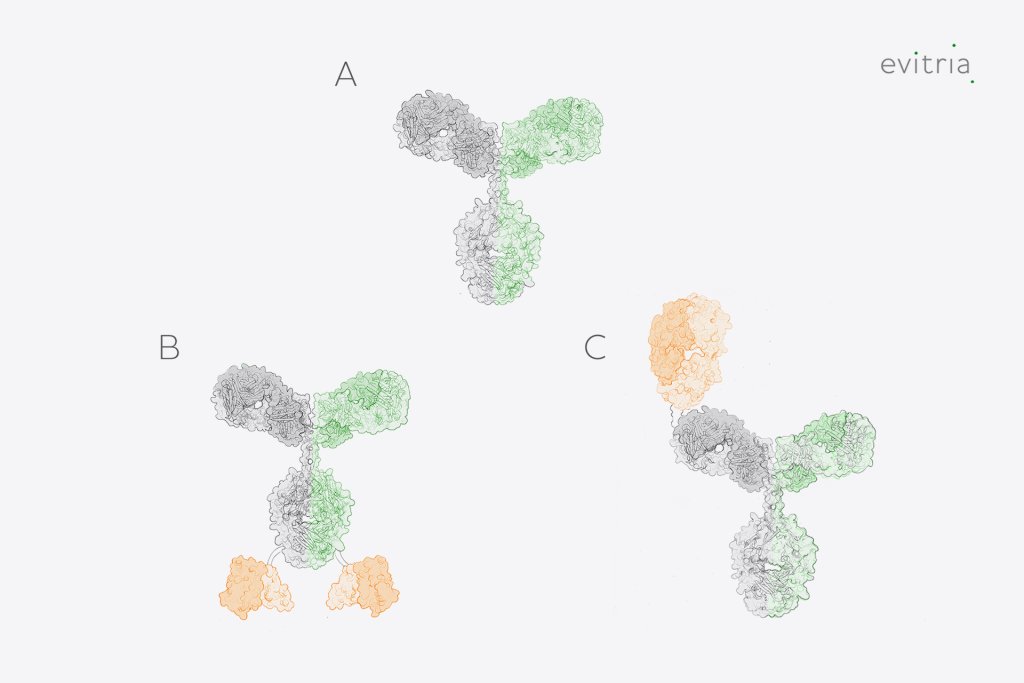
Additional structural characterization can be made by looking at the bsAb format and the sequences used to join the different domains. “Traditional” structures closely resemble regular monoclonal antibodies (mAbs) but have different binding domains on each Fab arm (Figure 2A). These can be further enhanced by the addition of other binding regions, such as scFvs, VHHs or Fab domains, which leads to the creation of higher-order multi-specific molecules, such as trispecifics (Figures 2B and 2C).
Non-antibody bispecifics can be created through the linkage of binding domains without Fc regions. These domains can be antibody fragments, such as individual scFvs (common with bispecific T-cell engagers), Fab domains, VHH domains, or other proteins with an affinity for the desired target(s).
Finally, additional modifications may be added to augment the function of the bispecific molecule. For T-cell engaging trans co-engagers, Fc silencing is typically applied to prevent FcγR-mediated off-target activation and cytokine release. However, formats engaging innate immune effector cells may deliberately retain or enhance Fc effector function.
The choice of which bispecific antibody to use is non-trivial and should be made through a combination of biological application, manufacturing, and commercial considerations. We are happy to assist you with this decision.
For asymmetric bispecific formats such as knobs-into-holes, CrossMab and electrostatic steering, the transfection ratio of heavy chain and light chain plasmids is one of the most impactful variables for heterodimer yield, yet it is frequently overlooked. Across thousands of bispecific transfections, we have found that the optimal ratio is rarely 1:1:1.
We therefore screen multiple plasmid ratios during the pilot study phase, where even modest adjustments can raise heterodimer content by 10 to 20 percentage points. If you are planning bispecific production, we recommend optimizing the ratio rather than relying on default equimolar conditions.
Which bispecific format should you choose?
If your priority is…
Consider
Why
An IgG-like molecule with a long half-life
DuoBody®, Knobs-into-Holes, CrossMab
Retain the Fc region and a natural antibody architecture
Correct light-chain pairing
CrossMab, disulfide engineering or electrostatic steering
Different options to prevent light-chain mispairing
Higher valency or avidity
IgG-scFv (2+2)
Adds binding sites per target, symmetric structure makes it easier to manufacture
Long-lasting, healthy customer relationships are very
important to us. Anonymity is therefore part of our corporate DNA.
“We have been working with evitria for several years and highly appreciate the high consistency of the delivered material.”
Sr. Scientist, Biotherapeutics, Switzerland
“We have been working with evitria since 2022. We appreciate the openness and flexibility of the team, the high speed and quality of the proteins they deliver.”
Radiopharm Theranostics Ltd.
“We are happy paying for the assured quality that evitria brings.”
Sr Scientist, Biotherapeutics, Series B Startup, Boston
Unsure on what bispecific format you should use?
We’ve got you covered! Regardless of where your research is taking you, Julia Pizzolato is dedicated to supporting you on our bispecific antibody production service.
Bispecific antibody production service provided by evitria
Our extensive experience in bispecific antibody production service covers all major formats as well as proprietary, highly engineered, or unusual constructs. Many FDA-approved bispecific antibodies rely on exactly these formats, from DuoBody® to knobs-into-holes. The table above summarises how each format works. Below, our scientists explain when we recommend each format and how we reach clean, assay-ready material in transient CHO.
For that aim, we support bispecific antibody formats like:
DuoBody® System (Genmab)
We recommend the DuoBody® format when you need an IgG-like molecule with native antibody architecture and predictable developability. In our transient CHO workflow, the two parental antibodies are produced in parallel and joined by controlled Fab-arm exchange, so you move from sequence to assay-ready bsAb fast, without re-engineering your lead. Because assembly builds on the natural IgG scaffold, downstream behavior stays predictable, and the format transfers cleanly from early screening to larger campaigns.
IgG-scFv
The IgG-scFv format is our go-to when a project needs higher valency or avidity while keeping an IgG-like backbone. Because performance depends heavily on the individual scFv, we screen construct and linker variants early, and where a fragment tends to misfold or aggregate, we stabilize it with our Opti-mAb® approach before scale-up. Material is then polished to high monomer content and released against our standard analytics, so the avidity you designed for is the avidity you receive.
Knobs-into-Holes, CrossMab, Electrostatic Steering, and Related Formats
When a program calls for a strict 1+1 architecture, we combine engineering strategies (knobs-into-holes, CrossMab, disulfide bridge engineering, and electrostatic steering) to enforce correct heavy- and light-chain pairing. Which one we reach for depends on your molecule; often we pair two approaches to suppress both residual homodimers and mispaired species. We tune transfection ratios per construct, remove homodimers during purification, and confirm the intended pairing by LC-MS before release, so heterodimer purity is verified, not assumed.
We know how tight timelines in biotechnological projects can be. With resources and know-how at hand, our efficient workflow allows us to provide you with recombinant antibodies within only 4 weeks. Starting with a pilot study, large-scale expression commences after 2 weeks, followed by purification, extensive analytics, and – finally – shipment of the deliverables to our customers worldwide.
Week 1
Week 2
Week 3
Week 4
Pilot Study*
Larger-scale expression
Purification
Final analytics
Shipment
0
1
2
3
4
5
6
7
8
9
10
11
12
13
14
15
16
17
18
19
Business days
Expert tip from evitria’s scientific team: why we always start with a pilot study
For novel bispecific constructs, we always recommend starting with a pilot study that tests different formats and technologies in parallel. This gives you critical data on expression level, chain pairing efficiency, and aggregation propensity at a small scale, so you can choose the best fit for each molecule before committing resources to larger-scale production.
The pilot typically adds 2 to 4 weeks to the standard timeline, but it dramatically reduces the risk of locking into a suboptimal format that creates problems downstream.
How are bispecific antibodies made? 6 steps
The production of bispecific antibodies (bsAbs) involves sophisticated in vitro protein engineering and advanced production techniques. Below is an overview of the key aspects of their production process:
1. Antibody engineering and cloning
Bispecific antibodies (bsAbs) are engineered by assembling two distinct antigen-binding domains, each with a defined specificity, into a single construct using recombinant DNA technology. This results in bispecific formats such as tandem scFvs, IgG-scFv fusions, or asymmetric IgG constructs with distinct Fab arms. If you work with us, we review your target biology, intended mechanism of action, and downstream development plans to recommend 2-4 candidate formats.
2. Expression systems for antibody production
BsAbs are produced using various expression systems, including mammalian cells, yeast, or bacterial systems. While simpler fragment-based formats can sometimes be expressed in bacterial or yeast systems, full-length bispecifics with Fc domains require mammalian expression systems, particularly CHO cells, to ensure proper folding, glycosylation, and effector function.
3. Transfection and protein expression
The bispecific antibody genes are introduced into the expression system through transfection, initiating the production of bispecific antibody molecules. Depending on the format, two to four distinct polypeptide chains are co-expressed and must assemble correctly into the intended bispecific product.
4. Chain pairing and heterodimerization
In recombinant bispecific production, the two distinct arms must assemble into the correct heterodimer rather than into homodimers or mispaired species. Engineering strategies such as knobs-into-holes, CrossMab domain crossover, electrostatic steering, and controlled Fab-arm exchange bias assembly toward the intended pairing, while each light chain is matched to its correct heavy chain. Optimizing the transfection chain ratios further raises the proportion of correctly paired bispecific antibody, which reduces the downstream purification burden and improves final heterodimer purity.
5. Protein purification
BsAb production involves multiple purification steps to obtain highly pure and active molecules. Techniques such as ion exchange chromatography, protein A affinity chromatography, or peptide tagging are employed to isolate and enrich bsAbs from the expression system.
6. Antibody characterisation and quality control
After antibody purification, bispecific antibodies undergo rigorous characterization and quality control assays. These assays assess their binding specificity, stability, and effector functions. The bispecific antibodies are also evaluated for their pharmacokinetics, half-life, and ability to engage with target cells.
Accelerating Bispecific Success with Opti-mAb® Technology
Through our strategic partnership with AAX Biotech, evitria seamlessly integrates 15+ years of exclusive CHO transient expression expertise with cutting-edge Opti-mAb® technology to solve the industry-wide challenge of scFv instability. Single-chain variable fragments (scFvs) are essential building blocks for bispecific antibodies, but their tendency to misfold and aggregate frequently leads to manufacturing bottlenecks and project cancellations.
By stabilizing single-chain variable fragments early, Opti-mAb® improves developability and thermal stability, reduces aggregation, and turns challenging scFv-based bispecific constructs into stable, high-yield material, all within evitria’s 4-week transient CHO workflow.
By applying this proprietary molecular stabilization strategy, we eliminate aggregation risks and deliver up to 37x higher yields and greater than 95% purity, all within our rapid 4-week turnaround time. This partnership allows you to address critical developability risks early, transforming even the most complex and challenging bispecific constructs into highly stable, manufacturable therapeutics without compromising on Swiss precision or scientific flexibility.
Fast-tracking bsAb projects has become a strategic advantage, enabled by advances in transient expression, purification, and protein engineering.23 However, compressed timelines carry a risk of suboptimal design and reduced analytical scrutiny, which can jeopardize long-term scalability. It’s crucial to balance speed with quality from the outset to avoid costly failures. Read more: Fast-Tracking Bispecific Antibody Development: What Can Go Wrong?
Our experts are happy to discuss our process with you and provide a detailed breakdown of prices for your specific project.
Accelerate early-stage antibody discovery with parallel CHO expression of up to several hundred constructs per project.
evitria’s HTP antibody production service delivers purified, assay-ready antibodies within 4 weeks – with the same Swiss-quality analytical package used at clinical scale. No host-cell transitions, no re-optimization, no delays.
Both monoclonal and bispecific antibodies come with numerous benefits, but have several differences that set them apart. We will review them in this article.
Bispecific drugs hold immense promise in revolutionizing therapeutic interventions across various medical fields. In this article, we explore three examples of bispecifics and their applications, illuminating their remarkable potential in advancing patient care.
Despite the enormous progress that has been made in the field of bsAbs, the side effects related to their administration have to be considered as well. In this article, we provide a general overview of possible side effects.
BsAbs are a comparatively new and extremely promising class of antibodies. In this article, we provide an overview of bispecific antibodies, including their mechanism of action and expressions.
Especially in the past decade, the FDA has approved several bispecific antibody (bsAb) products, revolutionizing the treatment of myriad medical conditions. In this article, we will take a look at the bsAbs currently approved by the FDA.
In this article, we’ll explore the different types and formats of bsAbs, their unique features, and therapeutic applications. Additionally, we’ll highlight evitria’s role in advancing bsAb development.
Dr. Stefan Schmidt
You may also be interested in one of our other expression services
We produce all major bispecific formats, including DuoBody®, knobs-into-holes, CrossMab, electrostatic steering, IgG-scFv, tandem scFv (BiTE-like), and VHH-based constructs, as well as proprietary or unusual designs. If you are unsure which format fits your project, we help you choose the most suitable one for your target and application.
Our bispecific antibody production service delivers microgram to gram quantities of purified, research-ready antibody, typically at greater than 95% purity and in as little as 4 weeks from sequence to antibody. For challenging scFv-based constructs, our Opti-mAb® technology can achieve up to 37 times higher yields.
To start, we need the sequences of your bispecific antibody. If you have already chosen a format, we work with your design; if not, we help you select one. Antibody sequencing is not included, but we can connect you with established sequencing partners, so you have a seamless path from sequence to purified bispecific antibody.
We select a pairing strategy per format, such as knobs-into-holes, CrossMab, or electrostatic steering, optimize transfection chain ratios, and add polishing steps to remove homodimers and mispaired species. Heterodimer identity and purity are confirmed by LC-MS.
At evitria, we use transient expression in CHO cells for our bispecific antibody production service. This allows us to produce various antibody formats in outstanding quality. Additionally, CHO cells are an expression system feasible both for early-stage assays in drug discovery and large-scale production of recombinant proteins, as the mammalian cell culture can perform high throughput protein expression and thus achieve high yields. Furthermore, CHO cells perform the complex post-translational modifications, such as human-compatible glycosylation, that are crucial for therapeutic antibodies, for example to enable antibody-drug conjugates or to enhance ADCC. CHO is also the industry standard for therapeutic antibody production, which simplifies the later transition to clinical development.
No, evitria specializes in transient transfection. This approach allows for the rapid and efficient generation of antibodies for both small-scale research and larger production. It is more flexible than using stable cell lines and lets us deliver high-quality antibodies in as little as 4 weeks.
No, our service starts once the sequences are ready, since they are the blueprint we need to express your bispecific antibody. We do not sequence in-house, but we can connect you with established sequencing partners for a seamless path from sequence to purified antibody.
Yes, our expertise extends beyond bispecific antibodies. We offer recombinant antibody expression services and also provide a comprehensive protein production service for a wide range of proteins. Our technology and experience allow us to offer high-quality, efficient services tailored to your specific project needs.
Wei, J., et al. “Current landscape and future directions of bispecific antibodies in cancer immunotherapy.” Frontiers in Immunology, vol. 13, 2022, p. 1035276. https://doi.org/10.3389/fimmu.2022.1035276↩︎
Labrijn, A. F., et al. “Bispecific antibodies: a mechanistic review of the pipeline.” Nature Reviews Drug Discovery, vol. 18, no. 8, 2019, pp. 585-608. https://doi.org/10.1038/s41573-019-0028-1. ↩︎
Klein, C., et al. “The present and future of bispecific antibodies for cancer therapy.” Nature Reviews Drug Discovery, vol. 23, no. 4, 2024, pp. 301-319. https://doi.org/10.1038/s41573-024-00896-6↩︎
Let’s get in touch with our experts now!
Our team of experts looks forward to answering all your concerns regarding our services and solutions.