eviCONTROL – Recombinant Isotype Controls For Therapeutic Antibody R&D
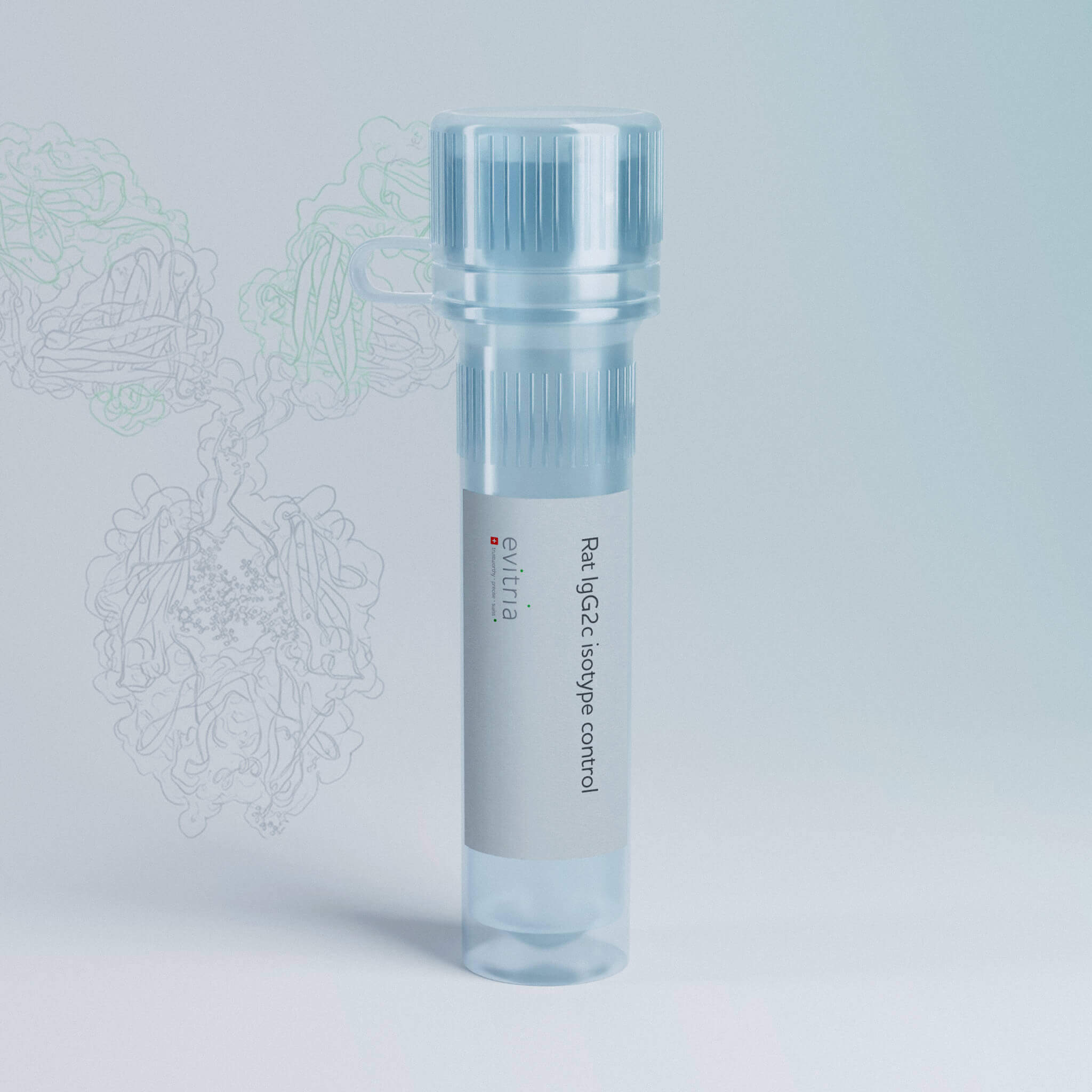
eviCONTROL antibodies are sequence-defined recombinant isotype controls, produced on the same CHO platform as evitria’s therapeutic antibody projects.
They are available in wild-type and reduced-effector-function versions, unconjugated, and in quantities suitable for both in vitro and in vivo work.
Specifications And Documentation
| Attribute | eviCONTROL standard |
|---|---|
| Production | Recombinant, transient CHO, animal-component-free |
| Purification | Protein A affinity |
| Purity | ≥ 98 % monomericity by SEC-HPLC |
| Endotoxin | ≤ 1 EU/mg |
| Formulation | Dulbecco’s PBS (pH 7.2-7.4) |
| Storage and shipping | Stored at -80°C, shipped at 4°C or on dry ice |
| Documentation | Certificate of Analysis covering identity, concentration, quantity, purity, endotoxin, buffer |
Irrelevant specificity: eviCONTROL antibodies carry a defined, non-target-binding variable region against RSV. If this could potentially interfere with your assay format, we are happy to discuss other unrelated targets and produce them for you.
A note on the LALA variants
L234A/L235A (EU numbering; equivalent to L247A/L248A in Kabat numbering) strongly reduces binding to FcγRI, FcγRIIa and FcγRIIIa and correspondingly reduces ADCC and ADCP. It does not abolish all effector function: residual C1q binding and residual CDC have been reported for LALA-only variants, which is why fully silenced designs combine LALA with additional substitutions such as P329G, or use alternative silencing strategies.1 2
If your candidate carries a fully silenced Fc, including P329G-LALA, LALA-PG, aglycosylated variants or evitria’s STR silencing technology, request a matched control rather than using a LALA control. See STR True Fc Silencing Technology and Fc-silenced antibody production service.
What are Isotype Control Antibodies?
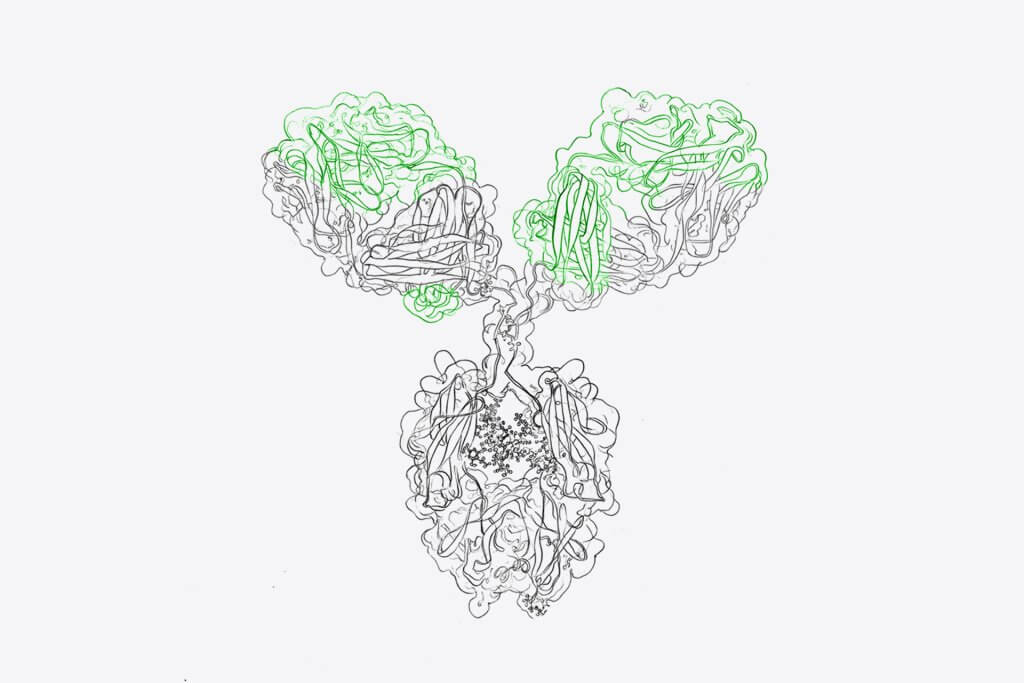
An isotype control is an antibody of the same species, heavy chain class and subclass, light chain class and format as your test antibody, but with an irrelevant specificity. Isotype controls are there to ensure that the signal that you see with the test antibody is coming from target binding and not from unspecific Fc-related effects. These effects can include:
- Fcγ receptor engagement on target or effector cells3 4
- C1q binding and complement activation3
- FcRn-driven persistence and non-specific clearance in vivo5
- Crosslinking by aggregated IgG, which can drive activation and cytokine release on its own6
- Contributions from the buffer and the formulation
An isotype control does not control for the non-specific binding of your own candidate. Clone-specific stickiness is driven largely by the variable domains, through surface charge patches, hydrophobic patches and polyreactivity, and these properties differ between any two clones.7 8 An isotype control therefore complements, but does not replace, candidate-specific specificity and polyreactivity testing.
Isotype controls remain highly informative where the background is potentially Fc-mediated or reagent-related: binding or functional assays, such as cytotoxicity assays, cytokine release assays, biosensor measurements, tissue staining and in vivo studies.
Isotype control antibodies from evitria
Our selection of isotype control antibodies is tailored to correspond with the class and subclass of monoclonal antibodies generated through our recombinant expression services. This alignment supports a closely matched control design with your therapeutic candidates, optimizing the accuracy of your experimental controls in advanced functional and binding studies. Benefits for you include:
- Quality assurance
Produced with rigorous standards to ensure very low endotoxin levels, high purity, consistency, and reliability for in vitro and in vivo models. - Extensive range
A precise selection of isotype controls tailored to specific species, subclasses, and Fc-engineered variants. - Expert guidance
Support from our team in selecting appropriate isotype controls for your highly specific therapeutic research needs
To complement your assay requirements, we also offer eviSIMILAR positive controls and reference antibodies, including chimeric anti-CD20 (rituximab), chimeric anti-EGFR (cetuximab), and humanized anti-HER2 (pertuzumab) analogs.
CHO
Expression System
Protein A
Purification
< 3 Days
Worldwide Shipping
9
eviCONTROLs available
Request Isotype Controls
Send us your inquiry, and we will contact you promptly with details.
Applications of isotype control antibodies
Isotype control antibodies are utilized across a wide range of preclinical analytical methods. Key areas of application for therapeutic R&D include:
01
Binding and biophysical assays
In SPR, BLI and ELISA, an isotype control identifies non-specific binding to the sensor surface, the reference channel, capture reagents and blocking agents. Example: run a wild-type human IgG1 control at the same concentration series as your candidate over an immobilised antigen surface to separate specific binding from bulk and surface effects.
02
Cell-based functional assays
In ADCC, ADCP, CDC, reporter gene, proliferation and cytokine release assays, an isotype-matched non-binder shows whether the response is antigen-dependent or driven by Fc engagement and aggregates. Example: an afucosylated human IgG1 control alongside a GlymaxX-enhanced candidate in an NK-cell ADCC assay; a LALA control alongside a LALA candidate in an FcγR-dependent reporter assay.
03
Tissue staining
In IHC and immunofluorescence, an isotype control at matched concentration reports background from endogenous Fc receptors, hydrophobic trapping in stroma and necrotic areas, and detection-system background. Autofluorescence and blocking controls are needed in addition.
04
In vivo preclinical models
An isotype control provides the target-independent baseline. In PK studies it reports non-specific clearance and FcRn-driven half-life, against which target-mediated disposition is assessed.5 In efficacy studies it reports the contribution of vehicle, non-specific IgG exposure and passive accumulation in tissue. The control should match the species and subclass of the test article in that strain, and be dosed at the same level by the same route in the same formulation.
Selecting an isotype control
Match the following attributes to your test antibody. Items 1 to 4 are essential; items 5 to 9 matter whenever Fc function, in vivo behaviour or low signal-to-noise are involved.
- Species of origin. Also check compatibility with your anti-species detection reagents.
- Heavy chain class and subclass. This is what determines Fc receptor and complement engagement, and it often matters more than the target. Human IgG1 and IgG3 engage FcγRs and C1q strongly; IgG2 binds FcγRIIa-H131 selectively and C1q weakly; IgG4 is effectively non-complement-fixing and skews toward FcγRIIb.3 4 In mouse, IgG2a is the effector-competent subclass and IgG1 is comparatively inert, which is why both are offered here. Note that C57BL/6 and related strains express IgG2c rather than IgG2a.
- Light chain class, kappa or lambda.
- Fc engineering. A candidate with reduced or enhanced effector function requires a control carrying the same modifications, otherwise the comparison measures Fc engineering rather than specificity.1 2
- Glycoform and expression host. Core afucosylation raises FcγRIIIa affinity and ADCC by roughly one to two orders of magnitude,9 and galactosylation modulates C1q binding and CDC.10 An afucosylated candidate should be benchmarked against an afucosylated control.
- Concentration and dose. Run the control at the same concentration or dose as the test antibody. Mismatched concentration is one of the most common sources of misleading control data.
- Aggregate content. Aggregated IgG crosslinks FcγRs and can trigger activation and cytokine release independently of specificity.6
- Formulation. Same buffer, same excipients, and for in vivo work carrier-free, azide-free, low endotoxin and sterile filtered.
- Allotype, where relevant for human IgG1 (G1m3 / G1m17).


Unsure on what isotype controls you need?
We’ve got you covered! Regardless of where your research is taking you, our experts are dedicated to supporting you.
When An Isotype Control Is Not The Right Control
| Situation | Appropriate control |
|---|---|
| Western blot, immunoprecipitation | Knockout or knockdown lysate for antibody specificity |
| Gating in polychromatic flow cytometry | Fluorescence-minus-one controls and internal biological negatives11 12 13 |
| Fc receptor background on primary cells | A dedicated Fc receptor block, in addition to an isotype control |
| Bispecific and non-IgG formats | A format-matched construct with null binding arms, not a plain IgG1. (Bispecific Antiboy Production Service) |
| Fc-engineered or glycoengineered candidates | A control carrying the same Fc mutations and glycoform |
Custom And Matched Controls
Because eviCONTROL antibodies are produced on evitria’s standard CHO expression platform, controls can be adapted rather than taken as-is:
- Additional human subclasses (IgG2, IgG3, IgG4) and mouse subclasses (IgG2b, IgG2c, IgG3)
- Other host species, on request
- Fully silenced Fc variants, including P329G-LALA, LALA-PG, aglycosyl N297A/Q, and STR-silenced formats
- Afucosylated controls for ADCC-enhanced candidates
- Fab and F(ab’)2 formats
- Controls produced alongside your own expression project, from the same platform, same host and same purification route
- Bulk quantities for in vivo studies
Regulatory Status And Conditions Of Use
- eviCONTROL antibodies are supplied for Research Use Only. They are not for use in humans, and not for clinical, diagnostic or therapeutic applications.
- They are not manufactured under GMP.
- Not for resale or redistribution.
- International nonproprietary names are used solely to identify reference sequences. evitria is not affiliated with, sponsored by or endorsed by the originator companies, and no endorsement is implied.
- Sale conveys no licence under any third-party patent. Customers are responsible for determining freedom to operate in their jurisdiction and application.
FAQs about isotype control antibodies
An antibody matched to your test antibody in species, heavy chain class and subclass, light chain class and format, but with an irrelevant specificity. It reports background arising from the antibody scaffold and the reagent, including Fc receptor and complement engagement, aggregate-mediated effects, and label or buffer effects.
No, and this is a common misconception. Clone-specific non-specific binding is driven largely by the variable domains and is not reproduced by an irrelevant antibody of the same isotype [5,6]. An isotype control is a scaffold and reagent control, not a substitute for candidate-specific specificity or polyreactivity testing.
Human IgG1 wild type, human IgG1 LALA, mouse IgG1 wild type, mouse IgG2a wild type and mouse IgG2a LALA, all unconjugated. Additional subclasses, species, Fc variants and glycoforms are available on request. See the portfolio table for light chain, engineering and pack sizes.
They have strongly reduced FcγR binding and correspondingly reduced ADCC and ADCP, but LALA alone retains some C1q binding and residual CDC [10,11]. If your candidate uses a fully silenced design such as P329G-LALA, LALA-PG, an aglycosyl variant or STR, request a matched control instead.
Residues are given in EU (Edelman) numbering, the standard for antibody constant region numbering.
Transient CHO. Host and process determine the glycoform, which matters whenever Fc-mediated function is part of the readout [12,13].
No. eviCONTROL antibodies are supplied unconjugated and are intended for functional, biophysical and in vivo work, with secondary detection where a label is required. Fluorochrome-to-protein ratio therefore does not apply. If you conjugate in-house, match the degree of labelling between control and test antibody.
Yes, and it is standard practice. Match subclass, Fc engineering and glycoform, and run at the same concentration as the candidate. Note that afucosylated candidates require afucosylated controls for a meaningful comparison [12].
Yes, they are suitable for preclinical in vivo studies. Match species, subclass, dose, route and formulation to the test article.
Yes. Controls can be produced on the same platform, in the same host and by the same purification route as your candidate, including custom isotypes, Fc variants, glycoforms and fragment formats.
A Certificate of Analysis covering identity, concentration, purity by SEC and CE-SDS, endotoxin, buffer. Additional characterisation data on request.
No. They are for Research Use Only, are not intended for use in humans, and are not for resale.
Select the product and quantity, or send us your requirements, and we will confirm availability, delivery and payment details. Technical support is available if you would like help selecting a control.
References
- Schlothauer T, Herter S, Koller CF, et al. Novel human IgG1 and IgG4 Fc-engineered antibodies with completely abolished immune effector functions. Protein Engineering, Design and Selection. 2016;29(10):457-466. DOI: 10.1093/protein/gzw040 ↩︎
- Lo M, Kim HS, Tong RK, et al. Effector-attenuating substitutions that maintain antibody stability and reduce toxicity in mice. Journal of Biological Chemistry. 2017;292(9):3900-3908. DOI: 10.1074/jbc.M116.767749 ↩︎
- Bruhns P, Iannascoli B, England P, et al. Specificity and affinity of human Fcγ receptors and their polymorphic variants for human IgG subclasses. Blood. 2009;113(16):3716-3725. DOI: 10.1182/blood-2008-09-179754 ↩︎
- Vidarsson G, Dekkers G and Rispens T (2014) IgG Subclasses and Allotypes: From Structure to Effector Functions. Front. Immunol. 5:520. DOI: 10.3389/fimmu.2014.00520. ↩︎
- Dua P, Hawkins E, van der Graaf PH. A tutorial on target-mediated drug disposition (TMDD) models. CPT: Pharmacometrics & Systems Pharmacology. 2015;4(6):324-337. DOI: 10.1002/psp4.41 ↩︎
- Vessillier S, Eastwood D, Fox B, et al. Cytokine release assays for the prediction of therapeutic mAb safety in first-in-man trials. Journal of Immunological Methods. 2015;424:43-52. DOI: 10.1016/j.jim.2015.04.020
↩︎ - Kelly RL, Sun T, Jain T, et al. High throughput cross-interaction measures for human IgG1 antibodies correlate with clearance rates in mice. mAbs. 2015;7(4):770-777. DOI: 10.1080/19420862.2015.1043504
↩︎ - Hötzel, I., Theil, F. P., Bernstein, L. J., et al. (2012). A strategy for risk mitigation of antibodies with fast clearance. mAbs, 4(6), 753–760. DOI: 10.4161/mabs.22189 ↩︎
- Shields RL, Lai J, Keck R, et al. Lack of fucose on human IgG1 N-linked oligosaccharide improves binding to human FcγRIII and antibody-dependent cellular toxicity. Journal of Biological Chemistry. 2002;277(30):26733-26740. DOI: 10.1074/jbc.M202069200 ↩︎
- Peschke B, Keller CW, Weber P, Quast I, Lünemann JD. Fc-galactosylation of human immunoglobulin gamma isotypes improves C1q binding and enhances complement-dependent cytotoxicity. Frontiers in Immunology. 2017;8:646. DOI: 10.3389/fimmu.2017.00646 ↩︎
- O’Gorman MRG, Thomas J. Isotype controls: time to let go? Cytometry. 1999;38(2):78-80. ↩︎
- Maecker HT, Trotter J. Flow cytometry controls, instrument setup, and the determination of positive events. Cytometry Part A. 2006;69(9):1037-1042. DOI: 10.1002/cyto.a.20333 ↩︎
- Hulspas R, O’Gorman MRG, Wood BL, Gratama JW, Sutherland DR. Considerations for the control of background fluorescence in clinical flow cytometry. Cytometry Part B: Clinical Cytometry. 2009;76(6):355-364. DOI: 10.1002/cyto.b.20485
↩︎