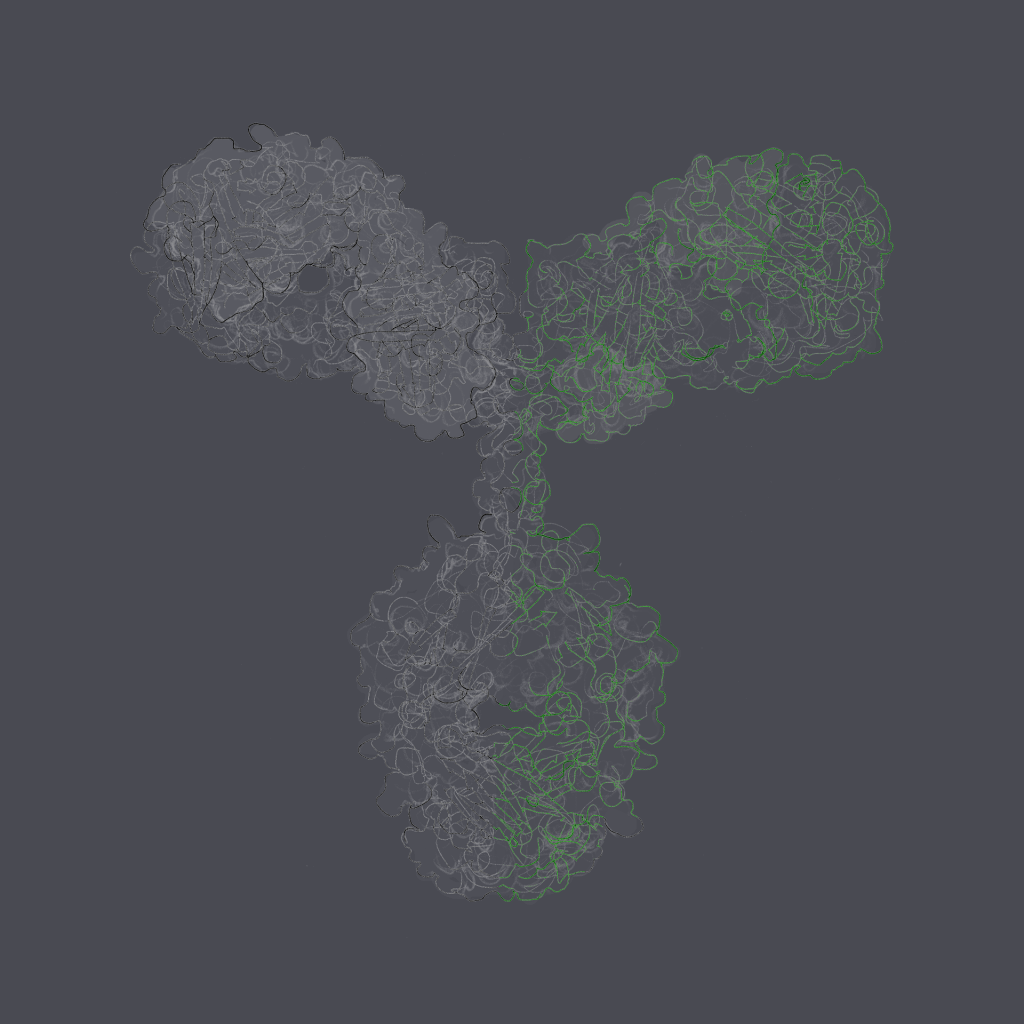
Take your project to the next level with high-quality recombinant antibody production services at evitria.
We provide recombinant antibody expression services with our well-established CHO cell platform, ensuring high-quality results from antibody sequences to delivery in as little as 4 weeks.
At evitria, we specialize in recombinant antibody production services using our optimized CHO cell expression platform. This allows us to deliver high-quality antibodies with low endotoxin levels (<1 EU/mg) from your antibody sequences, with turnaround times as short as four weeks.
Our recombinant antibody production services include producing a wide range of antibody types and formats. These services are:
Custom recombinant antibody production service – take advantage of more than a decade of experience
With over a decade dedicated to recombinant antibody production services, evitria has become a trusted partner for clients worldwide. Since 2010, we have performed over 140,000 transfections and purified more than 25,000 antibodies, serving customers ranging from academic laboratories to global biopharmaceutical companies.
Our expertise encompasses a wide range of expression services, including:
Isotype switching
Chimerization
Antibody humanization
Glyco-engineering
Bispecific and trispecific antibodies
Fusion antibodies, including Fc fusion proteins
Whether you need a partner to handle your complete antibody production or assistance with specific projects – our team is ready to provide tailored, reliable, and reproducible solutions.
Our recombinant antibody services cover a diverse array of antibody types and formats to suit your specific requirements. Here is an overview of the different types of specific antibodies that we at evitria can provide you with.
Recombinant Antibody Expression Service
Using our CHO cell line expression system, we produce high-quality recombinant monoclonal antibodies that surpass the functionality and reliability of traditional hybridoma-derived and polyclonal antibodies.1
Our process offers high throughput, flexible scalability, and is ideal for both discovery research and commercial manufacturing. With low endotoxin levels (<1 EU/mg) and rapid production timelines, we provide full-length antibodies and antibody fragments as a superior in vitro alternative to traditional in vivo methods.
Accelerate early-stage antibody discovery with parallel CHO expression of up to several hundred constructs per project.
evitria’s HTP antibody production service delivers purified, assay-ready antibodies within 4 weeks – with the same Swiss-quality analytical package used at clinical scale. No host-cell transitions, no re-optimization, no delays.
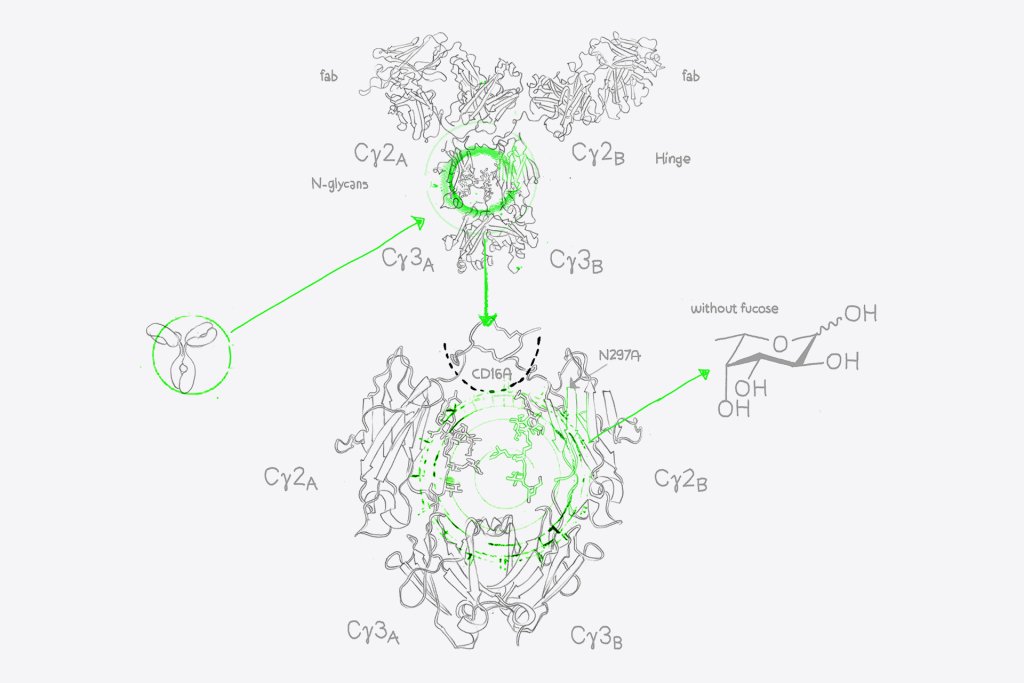
We offer the afucosylated (ADCC-enhanced) antibodies production service. These antibodies lack fucose residues in their Fc region, leading to enhanced antibody-dependent cellular cytotoxicity. This enhancement increases immunogenicity, thus therapeutic potency, and can reduce side effects.
For applications where immune system activation is undesirable, we produce antibodies with reduced or eliminated Fc effector functions.
Utilizing mAbsolve’s STR technology, we generate antibodies with truly silent Fc domains. These antibodies show no binding or activity above background levels across Fc gamma receptors, making them ideal for neutralizing interactions without triggering immune responses.
Our expertise extends to bispecific antibody production service, capable of simultaneously binding to two different antigens or epitopes. These complex molecules are valuable tools in therapeutic applications, offering targeted approaches in disease treatment.
As we have access to the bYlok® technology from Lonza, we are able to face one of the leading challenges in the bispecific antibody generation process: the correct pairing of heavy chains and light chains.
Beyond standard antibody formats, we produce fusion antibodies, including Fc fusion proteins, and other recombinant proteins such as scFvs (single-chain variable fragments), soluble extracellular domains, cytokines, and viral proteins.
Our flexible expression platform allows us to meet a wide range of protein production needs, providing nano-filtered, sterile supernatants suitable for various downstream applications. Furthermore, using CHO cells as our host cells of choice, we can provide not only maximum quality, but also reproducibility of different production processes.
Long-lasting, healthy customer relationships are very
important to us. Anonymity is therefore part of our corporate DNA.
“We have been working with evitria for several years and highly appreciate the high consistency of the delivered material.”
Sr. Scientist, Biotherapeutics, Switzerland
“We have been working with evitria since 2022. We appreciate the openness and flexibility of the team, the high speed and quality of the proteins they deliver.”
Radiopharm Theranostics Ltd.
“We are happy paying for the assured quality that evitria brings.”
Sr Scientist, Biotherapeutics, Series B Startup, Boston
Unsure on what recombinant antibody you should use?
We’ve got you covered! Wherever your research takes you, Jürgen Lübbehusen is here to support you every step of the way regarding our recombinant antibody expression service.
Recombinant monoclonal antibody production in CHO cells
Our CHO cell-based expression platform allows us to produce recombinant monoclonal antibodies with high purity, exceptional quality, and efficiency. Unlike Escherichia Coli and other bacterial expression systems, CHO cells can even achieve complex human-like post-translational modifications.
Furthermore, by utilizing transient expression of antibody genes in CHO cells, we eliminate the need for laboratory animal immunization, resulting in products free from animal contamination and ethical concerns.
This method also enables us to achieve shorter timelines and higher yields compared to traditional techniques (e.g. hybridoma technology), delivering fully functional antibodies that meet the rigorous demands of modern research and therapeutic applications.
Studies confirm that with a reliable system, these high-quality, transiently expressed antibodies can meet the necessary standards for clinical evaluation. An early commitment to scalable, reproducible expression methods is key for a successful transition to GMP manufacturing, regulatory approval, and commercial production.2
From the application in medicine and science to recombinant antibody production and the advantages of recombinant Abs in contrast to traditional monoclonal antibodies, this article will teach you all you need to know about recombinant antibodies.
A sequence-correct recombinant DNA construct can still fail during protein expression. Learn how cloning strategy, vector architecture, signal peptides and CHO-cell design influence antibody yield, assembly and quality.
There are several ways to produce recombinant proteins. In this article, we will have a look at some of them, and will focus on recombinant protein expression in mammalian cells.
The expression of recombinant antibodies has opened entirely new possibilities in life sciences. In this article, we will take a more detailed look at this process.
Recombinant antibody production is vital in drug development as well as for therapeutic and research purposes. In this article, we will discuss methods and benefits of recombinant antibody production.
We know how tight timelines in biotechnological projects can be. With resources and know-how at hand, our efficient workflow allows us to provide you with recombinant antibodies within only 4 weeks. Starting with a pilot study, large-scale expression commences after 2 weeks, followed by purification, extensive analytics, and – finally – shipment of the deliverables to our customers worldwide.
Week 1
Week 2
Week 3
Week 4
Pilot Study*
Larger-scale expression
Purification
Final analytics
Shipment
0
1
2
3
4
5
6
7
8
9
10
11
12
13
14
15
16
17
18
19
Business days
Our Solutions
Antibody Production Tailored to Your Specific Field
No, nor do we use E.Coli or HEK cells. Instead, we use mammalian cell cultures. We prefer Chinese Hamster Ovarian (CHO) cells in our mammalian expression system, since that comes with numerous advantages over the use of laboratory animals.
Recombinant antibody expression in CHO allows large-scale recombinant antibody production with low levels of endotoxin (<1 EU/mg). Moreover, CHO cell antibody production is much faster than any traditional technique. We are up to months faster than antibody suppliers relying on hybridoma cells.
Mammalian expression is the process of biological protein production in mammals or mammalian cells, such as HEK293 or CHO cells. Some proteins, such as antibodies, can’t be produced in fully functional form in other cell cultures.
evitria offers custom antibodies to their customers. Our service includes recombinant antibodies, afucosylated antibodies or other proteins. In contrast to a conventional antibody supplier, we do not offer a catalog with standardized antibodies.
Antibody engineering is the process of changing and optimizing antibodies to equip them with better or novel properties. In this case, the fab fragment is modified. One example is the fine-tuning of antigen binding sites on their variable regions to enhance affinity or specificity towards an antigen.
Another example is the fusion of two antibodies with distinct antigens, to form a bispecific antibody that shows affinity towards both antigens.
For the removal of residing reagents, amino acids and other byproducts, protein A purification is standard in biotechnology, and we use alternative resins such as Protein G, L, Kappa/Lambda-Select or anti-IgG-CH1 as needed. An additional size exclusion chromatography (SEC) purification step can be added, as well as ion exchange chromatography. Please inquire for more details
Our average timeline is between 4 and 6 weeks for new antibodies. If we have produced the antibody before then reproduction will take 2.5-3.5 weeks.
We have produced both bispecific and trispecific antibodies in various formats. Please contact your local evitria representative to discuss your specific project.
No, but please see our “Partners” page to find best-in-class solutions for required services.
No, but please see our “Partners” page to find best-in-class solutions for required services. We work together with established partners for optimization of mAb and rAb development workflows.
We are unable to send our proprietary expression vectors but can clone into a freedom-to-use vector and send for an additional fee.
There are various different formats of immunoglobulins, e.g. full-length IgG1, VHH, bispecific or chimeric abs.
A recombinant gene is a sequence of genetic code that is inserted into different genetic material by recombinant DNA technology. Recombinant gene sequences (previously undergone the process of gene synthesis) are used to transfer blueprints of enzymes and proteins (e. g. recombinant antibodies) into cells in order to have them produce said protein (e.g. for recombinant antibody technology).
At evitria, we focus on transient antibody production. Thereby, we rely on CHO cells as our expression system of choice, as they come with several advantages in terms of quality and speed.
No, evitria works with partners to ensure maximum value to customers. For sequencing issues in the production of recombinant antibodies, Rapid Novor is evitria’s partner.
Antibody phage display technology is a method used to study protein interactions, particularly in antibody development. It involves inserting genes encoding antibodies into plasmids, which are then introduced into bacteriophages. This process allows billions of antibodies to be presented on the surface of the bacteriophage. The resulting antibody library enables the selection of antibodies with high affinity for specific targets (e.g. with ELISA testing or western blotting), aiding in therapeutic antibody discovery and deve
Sources
Kunert, R., Reinhart, D. Advances in recombinant antibody manufacturing. “Advances in recombinant antibody manufacturing” Appl Microbiol Biotechnol100, 3451–3461, 2016. https://doi.org/10.1007/s00253-016-7388-9 ↩︎
Rodriguez-Conde, Sara, et al. “Suitability of Transiently Expressed Antibodies for Clinical Studies: Product Quality Consistency at Different Production Scales.” mAbs, vol. 14, no. 1, 2022, p. 2052228. https://doi.org/10.1080/19420862.2022.2052228. ↩︎
Let’s get in touch with our experts now!
Our team of experts looks forward to answering all your concerns regarding our services and solutions.