
The history of antibodies begins in 1890, when German physician Emil von Behring first demonstrated that immunity could be transferred between animals using serum — a discovery that earned him the first Nobel Prize in Physiology or Medicine in 1901.
The term “antibody” (from the German Antikörper) was coined just one year later, in 1891, by Paul Ehrlich — widely regarded as the father of modern immunology. From these early discoveries, antibody science evolved over 130 years into one of the most powerful tools in medicine and biopharmaceutical research.
This article traces the key milestones in antibody history — from 18th-century smallpox inoculation to today’s recombinant and monoclonal antibodies.
Antibody History: first experiences in the 18th century
First experiences in the field were made in the years 1714 to 1717. At that time, Lady Mary Wortley Montagu, Emanuel Timoni and James Pylarini were working on a smallpox inoculation.
Antibodies are pivotal in the acquisition of immunity to a disease that a patient has already encountered, a fact that has been known and documented for centuries. Until today, this knowledge forms the basis for extensive research and a medical specialized field commonly known as immunology.
Paul Ehrlich – father of modern immunology
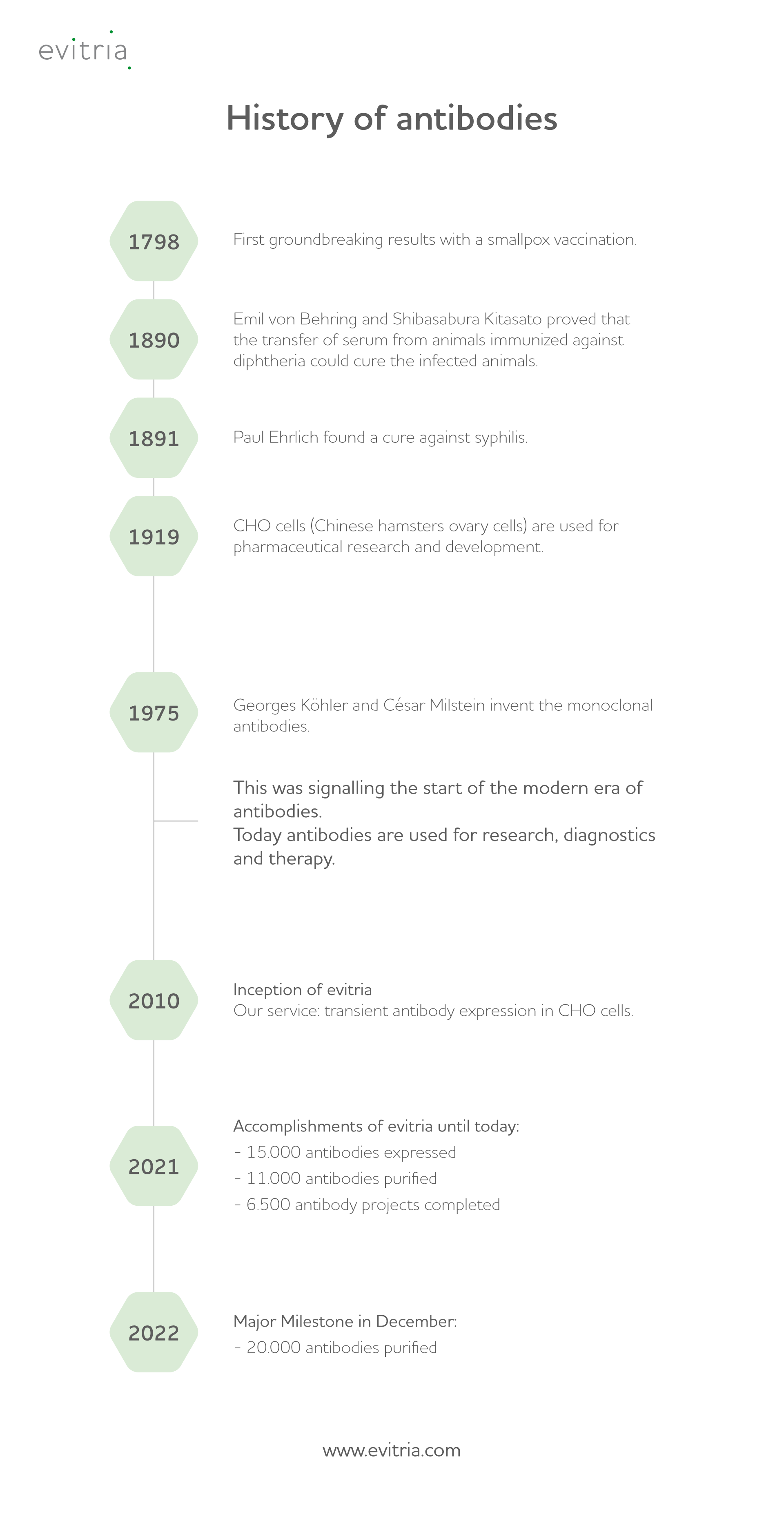
The term itself, which derives from the German “Antikörper”, was first coined in 1891 by Paul Ehrlich, a German Jewish physician and scientist who most notably found a cure against syphilis and who, together with Elie Metchnikoff, was awarded the Nobel Prize in 1908 for their work and insights into immunological defense.
First reference to antibodies
However, it was referenced prior to that, namely in 1890, when Emil von Behring, a German physiologist, and Shibasabura Kitasato, a Japanese physicist, proved that the transfer of serum from animals immunized against diphtheria to animals suffering from it could cure the infected animals.
Timeline showing the history of antibodies
From history to now: Antibody expression today
The modern era of antibody research began with the invention of monoclonal antibodies by Georges Köhler and César Milstein in 1975.
Today, antibodies are used for a number of applications in various medical and pharmaceutical fields such as research, diagnostics, and therapy. Researchers are inventing new cures for cancer or vaccines for viral diseases, such as against COVID-19.
While polyclonal antibodies are made using several immune cells and are widely used in research and diagnostics, monoclonal antibodies are the result of using identical immune cells that are all clones of a specific parent cell.
Read more: What are polyclonal antibodies? | Steps in antibody production
Due to their ability to target almost any cell surface or secreted molecule with remarkable efficacy and safety, antibodies offer unparalleled opportunities in the development of efficient drugs and therapies targeting a variety of diseases and illnesses.
What are antibodies and what types are there?
Antibodies are Y-shaped proteins produced by the human body to identify and neutralize foreign objects, more specifically viruses.
The human body’s immune system produces five types of antibodies, each of which has distinct methods of fighting disease and infection by identifying harmful infectious organisms due to their antigens.
- IgG accounts for around 75% of all antibodies in the human body
- IgA accounts for 15% of all antibodies in the human body; it is primarily found in mucosal tissues as well as in saliva, tears and breast milk
- IgM is one of the first antibodies recruited by the immune system to fight infection
- IgE is the antibody responsible for the allergic response mostly found in lungs, skin and mucosal membranes
- IgD is important in the early stages of the immune response
While there are “only” five types of antibodies, each antibody can produce an infinite number of different binding sites that match specific antigens.
In addition, antibodies can be divided into monoclonal antibody and polyclonal antibody types, most of which are artificially manufactured and manipulated to be used in different therapeutics. Just like their natural counterparts they are used to fight certain viruses in the human body.
Advanced Antibodies: Recombinant & Afucosylation
Recombinant antibodies (rAbs) are monoclonal antibodies that are generated in vitro using synthetic genes. They have a number of advantages in both medical and research applications and are used for the diagnosis of different toxins or pathogens.
In the past decade, several antibodies have been developed for therapeutic applications, primarily targeting tumor, inflammatory or immune diseases such as Crohn’s disease, psoriasis and various types of arthritis.
Afucosylated antibodies on the other hand are engineered monoclonal antibodies with the oligosaccharides in the antibody’s Fc region missing fucose sugar units. This type of antibody increases the antibody-dependent cellular cytotoxicity (ADCC antibody).
ADCC is important regarding the efficacy of cancer antibodies, however, due to nonspecific IgG competing with the drugs for binding to FcγIIIa on natural killer cells, many approved cancer antibodies have less ADCC than could be desired. Afucosylated monoclonal antibodies overcome this problem through improved FcγIIIa binding.
Our role in the history of antibodies
In today’s pharmaceutical and medical sector, antibody production and design plays a crucial role, to increase the activity, extend the half-life, reduce the immunogenicity or increase the functionality of an antibody.
evitria scientists have extensive expertise in antibody design and custom recombinant antibody. evitria offers recombinant antibody production service including afucosylated antibodies and any other protein for their customers. All projects are completed in a minimum of time and fulfill the highest quality standards in this industry.
One of the most recent additions to evitria’s portfolio is mAbsolve’s STR technology. Fc-silenced antibodies demonstrate reduced Fc-effector functions (such as cytokine release) in vivo, which is advantageous for therapeutic applications where activation of the host’s immune system would have negative effects.