

The principle of “garbage in, garbage out” has been a foundational concept in computing since the earliest days of data processing. Its relevance has only intensified with the rise of machine learning and artificial intelligence. AI models learn patterns from training data, and if that data is flawed, inconsistent, or incomplete, the resulting predictions will be unreliable regardless of algorithmic sophistication.
In antibody discovery, where AI promises to revolutionize how therapeutic candidates are identified and optimized, data integrity is essential. This is where a reliable High-Throughput antibody production service becomes critical. High-quality, consistent experimental data forms the foundation upon which successful AI-driven discovery is built.[1]
To address this challenge, Julia Pizzolato focuses on helping scientists who implement AI antibody discovery programs for therapeutic development. She explains why choosing the right production partner is essential for maintaining data integrity during early screening.
By leveraging professional High-Throughput antibody production, evitria helps researchers bridge the gap between digital sequence and physical validation. This focus ensures that therapeutic candidates maintain their viability throughout the transition from early discovery to large-scale manufacturing.
The Causal Link Between Laboratory Noise and AI Model Failure
Machine learning models for antibody design learn relationships between sequence, structure, and function from experimental datasets. These functions include binding affinity, expression yield, thermal stability, and aggregation propensity. The accuracy of these learned relationships depends largely on the quality of input data.
Training data for antibody AI typically derives from experimental characterization of antibody variants: binding measurements, biophysical assays, expression titers, and stability assessments. Each data point represents a sequence-property pair that contributes to model understanding. When hundreds or thousands of such pairs are aggregated, patterns emerge that enable prediction for untested sequences.
However, experimental data is inherently variable. Measurements differ between laboratories, instruments, operators, and experimental conditions. Protein quality varies with expression system, purification protocol, and handling. Even identical assays performed on different days can yield different results. This variability creates noise that obscures true sequence-function relationships.
When AI models train on inconsistent or inaccurate data, several problems emerge:
- Unreliable learning: Experimental noise and variable data create contradictory signals that models mistake for biology, undermining prediction accuracy.
- Overfitting to production context: Models become biased toward specific manufacturing conditions, limiting transferability to relevant production settings.
- Compounding inefficiency: Each iteration cycle yields diminished returns, wasting resources and promoting unsuitable candidates through the pipeline.
Quality In: Precision Biology for Valid AI Predictions
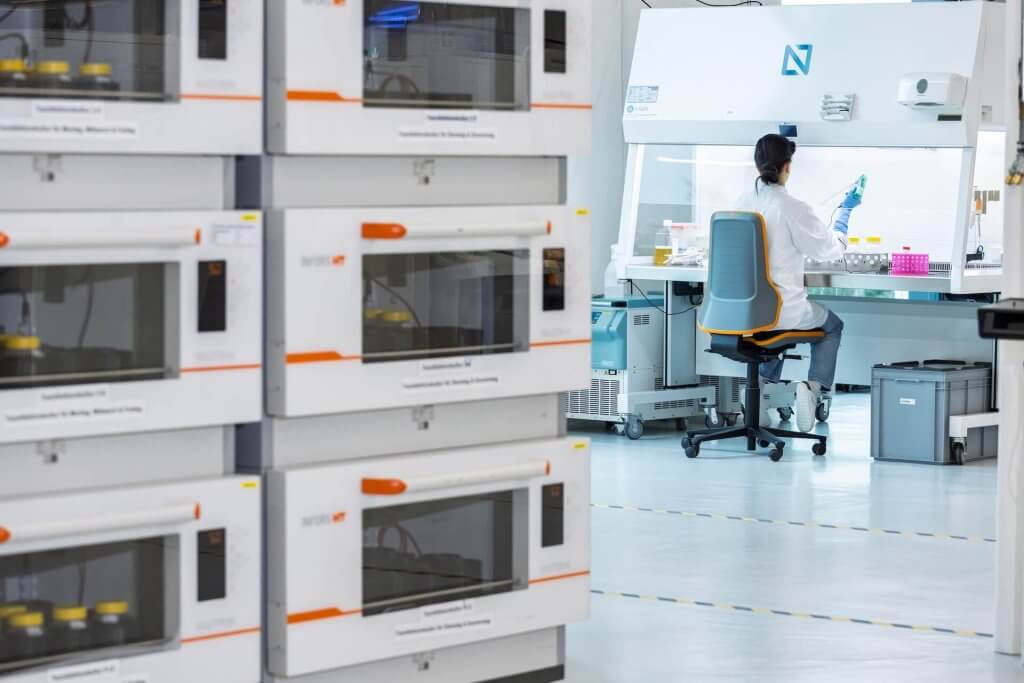
Generating data suitable for AI model training requires attention to several dimensions of quality:
- High throughput: Scalable workflows enabling rapid generation of large datasets to power robust model training and iterative refinement.
- Accuracy and precision: Validated assays and calibrated instruments yielding consistent, reproducible measurements that reflect true molecular properties.
- Consistency: Standardized protocols ensuring comparability across batches, timepoints, and variant sets.
- Completeness: Comprehensive characterization without data gaps that compromise pattern recognition.
- Relevance: Production in manufacturing-relevant systems with clinically meaningful assays.
Data quality begins with protein production. Variability in expression conditions, cell health, harvest timing, and purification protocols directly impacts the properties of resulting antibodies. An antibody that aggregates due to suboptimal expression conditions will yield misleading binding and stability data.
Standardized, well-controlled production processes minimize this variability. When every variant in a training set is produced using identical protocols, observed property differences can be confidently attributed to sequence rather than process variation. This clean signal enables more effective model learning.
Consistency becomes particularly critical when generating data across multiple batches or timepoints, as is common in iterative AI workflows. If production conditions drift between rounds, the model receives inconsistent training signals that impair learning. Rigorous process control ensures comparability across the entire dataset. The specific mechanisms by which automation enforces this consistency in transient CHO expression are examined in our article:
Why CHO-Native Data Is Essential for AI Antibody Training
If models are trained on material produced in surrogate host systems like HEK293, the resulting predictions will be optimized for this specific host. Candidates that perform well in these surrogate environments often fail to translate to the industry-standard CHO host used in manufacturing. Starting physical validation in CHO from the earliest iterations ensures that the AI learns manufacturing-relevant patterns.
This consistency is also relevant for the lab-in-the-loop discovery paradigm, where predictions and validation operate in tight iterative cycles. Utilizing CHO-native material from the start ensures that your entire digital pipeline remains anchored in biological reality.
AI-Grade Antibody Production Data: evitria’s CHO-Native Platform
At evitria, we recognize that AI-driven antibody discovery demands exceptional data quality. Our production platform is built on standardized, well-controlled processes that deliver consistent results across projects and timepoints. Every antibody is produced using validated protocols optimized for reproducibility, ensuring that sequence-property relationships are not obscured by process variability.
Our extensive analytical packages provide comprehensive characterization suitable for AI model training. Standardized methods and calibrated instruments ensure data accuracy and comparability. Whether supporting initial model training, iterative lab-in-the-loop refinement, or final candidate selection, our quality standards ensure that experimental results reliably inform computational predictions.
This approach effectively de-risks your entire development pipeline through the following pillars:
- Scientific Foundation: We provide both scientific expertise and efficient execution to produce your proteins for biochemical and cell-based HTS campaigns through our specialized CHO transient platform.
- Robotic Precision: Standardized execution ensures that the amino acid sequence remains the only independent variable in your dataset.
- Proven Consistency: Our Swiss precision guarantees that your training sets are free from the process noise that causes model overfitting.
Frequently Asked Questions on AI Antibody Discovery Data Integrity
Process noise overlays true biological signals with artificial variances from the manufacturing process, which the AI cannot distinguish from molecular properties. This leads to the model learning false correlations and delivering unusable or misleading results in practical applications.
Providing data that exactly matches the later manufacturing standard of the biopharmaceutical industry by utilizing a CHO-exclusive environment from the very first screening prevents this bias. This avoids the introduction of biased information from HEK293 cells and secures the integrity as well as the scalability of predictive models.
Mathematical normalization can smooth out some statistical outliers, but it can never replace the lack of biological precision in an unclean sample. As a rule, the attempt to save inferior data through complex algorithms only leads to an amplification of the underlying systematic error patterns.
Robotic automation minimizes the standard deviation within a test series and ensures absolute reproducibility of results under identical conditions. For an AI this means a significantly sharper signal, which massively increases the accuracy of predictions and the efficiency of the learning process.
True data integrity ensures that strategic decisions in early research are based on biological facts rather than artifacts of production. This reduces the risk of late-stage failure in development and protects the substantial investments made into new in silico-designed drug candidates.
Sources
- Technology Networks. Accelerating Antibody Discovery with AI and Machine Learning. Technology Networks Biopharma