

evitria’s High-Throughput Antibody Production Service is designed for a 4-week cycle from sequence approval to delivery of purified, analytics-confirmed material. This covers individual cloning, standardized transient transfection in CHO cells, Protein A purification, and full analytical quality control for every construct in the run.
Some providers complete comparable workflows in 2 weeks. The difference lies in the expression system and the scope of downstream characterization.
HTP Antibody Production Timelines: evitria vs. Rapid-Turnaround Providers
Several CROs advertise 2-week turnarounds for High-Throughput recombinant antibody expression. These timelines are achievable because they rely on HEK293 cells, bacteria or cell-free expression platforms, which have shorter expression windows than CHO cells.
The trade-off is manufacturing relevance. Approximately 70% of approved recombinant protein therapeutics are produced in CHO cells. HEK293-derived antibodies carry a different glycosylation profile: high-mannose-enriched glycans rather than the complex-type glycans characteristic of CHO expression.[1] Understanding the differences in HEK293 vs CHO for HTP expression reveals why the impact on glycosylation makes host-switching a false economy.
At the host-switch stage, this glycan difference can introduce aggregation or PK/PD changes. This is one of the main reasons why HTP screening results sometimes fail to translate to manufacturing. CHO-first screening therefore avoids late-stage failures and related costs.
evitria’s HTP antibody production uses the same CHO-based transient expression platform as the standard and large-scale production runs. The molecule you screen is the molecule you scale.
Why CHO-Based High-Throughput Antibody Production Takes 4 Weeks
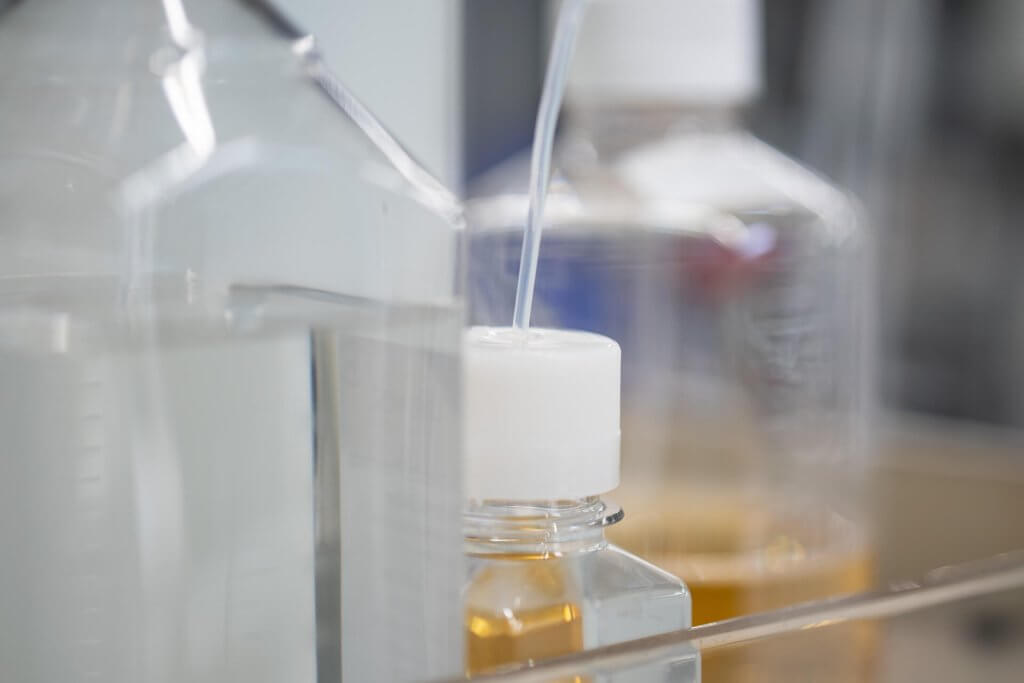
The 4-week cycle reflects the minimum time required for the CHO-specific expression and purification pipeline that cannot be compressed without sacrificing data quality. Individual gene synthesis and cloning has to be done for each molecule. CHO transient transfection requires a longer cultivation window than HEK293. Protein A purification and full biophysical QC add further days.
The analytical package included in evitria’s HTP platform is not standard in rapid-turnaround services. HPLC-SEC and CE-SDS data per construct give an overview on purity and aggregation propensity.
Every project is initiated at evitria’s Zurich facility within 24 hours of approval. Standard antibody production in CHO delivers purified material in 4 weeks from sequence to delivery. All material meets >95% purity (Protein A purification) and <1 EU/mg endotoxin.
Plan Your HTP Antibody Screening with a CHO Specialist
If your program requires data directly predictive of manufacturing behavior, CHO-based HTP screening avoids the comparability work that a host-system switch introduces later. evitria does not operate from fixed service packages. Every project begins with a discussion of your molecule format, expression objectives, and decision stage. Turnaround time is one of the first parameters to factor into your HTP screening campaign design, alongside host system choice and analytical scope.
Request a bespoke proposal to find out whether a 4-week CHO-based HTP run fits your current discovery timeline.
Frequently Asked Questions About HTP Antibody Production Turnaround Times
evitria’s HTP service is designed for a 4-week cycle from sequence approval to delivery of purified material. This covers CHO transient transfection, Protein A purification, and biophysical QC (HPLC-SEC and CE-SDS) for each construct in the run.
Rapid 2-week timelines are typically achievable through HEK293 cells or cell-free expression platforms. Both are faster than CHO cells in the expression stage. The trade-off is that the resulting molecules may not behave the same in a CHO manufacturing environment, which can create comparability issues at scale-up.
For standard production runs with already available plasmids, evitria can deliver purified material in 2.5 to 3 weeks. For HTP runs, timeline options depend on the availability of DNA plasmids, library size and required analytics. Contact our team to discuss your specific program requirements.
Each construct includes concentration measurement, endotoxin testing, HPLC-SEC analysis for aggregation and monomer content, and CE-SDS for purity assessment. This biophysical profile supports candidate ranking before downstream scale-up.
The HTP workflow at evitria is optimized for standard IgG formats to maintain throughput and timeline consistency. Complex formats such as bispecific antibody production service require bespoke optimization for correct chain pairing and are handled as a separate service. However, we have a strong track record of expressing and purifying hundreds of different bispecific antibodies in parallel as well.
Sources
- [1] Croset, A., Delafosse, L., Gaudry, J. P., Arod, C., Glez, L., Losberger, C., Begue, D., Krstanovic, A., Robert, F., Vilbois, F., Chevalet, L., & Antonsson, B. (2012). Differences in the glycosylation of recombinant proteins expressed in HEK and CHO cells. Journal of biotechnology, 161(3), 336–348. https://doi.org/10.1016/j.jbiotec.2012.06.038