

The most devastating moment in a therapeutic pipeline is discovering that a “top-tier” lead cannot be manufactured at scale. While High-Throughput Screening (HTS) identifies potent binders, these results often fail to translate into a viable product. This disconnect is frequently rooted in the biological and biophysical noise generated when using surrogate host systems that do not mirror the final production environment.
A High-Throughput Antibody Production Service built on the manufacturing host from the start is the most direct way to close this gap.
This guide is written by Julia Pizzolato, PhD, Commercial Scientific Liaison at evitria. With a background spanning antibody engineering, emerging modalities, and translational science, she provides technical consultation on antibody design and development, connecting deep scientific understanding with strategic decision-making.
The Root Cause: Host-System Divergence
The primary reason HTS results fail to translate is the common practice of switching host-cells mid-project. Many researchers use HEK293 for early discovery due to its speed only to move to Chinese-Hamster-Ovary (CHO) cells for clinical manufacturing. This practice creates a significant hurdle often referred to as a host-system divergence or Translation-Trap. However, utilizing CHO cells does not inherently sacrifice speed. Knowing the true turnaround time for HTP antibody production helps balance rapid screening with reliable developability.
Changing hosts is like switching the operating system of your molecule. The cellular machinery used to build the protein changes which can fundamentally alter the final physical product. When the host changes, all early characterization of binding kinetics and developability must be re-verified at great expense.
Beyond host switching, when logistical variables remain uncontrolled across different runs, data integrity suffers further. Unnoticed batch effects in HTP antibody production often cause flawed candidates to be falsely prioritized, leading to inevitable failures during later validation stages
The full HTP antibody production workflow is described in our complete guide.
3 Biological Drivers of Manufacturing Failure

Even with identical sequences the host-cell dictates the final physical identity of the antibody. Discrepancies in these three areas are the most common causes of translation failure. Identifying these risks early is the only way to ensure clinical success.
1. Glycosylation and PTM Divergence
Post-translational modifications are host-specific and determine the functional identity of the molecule. HEK293 cells produce both 2,3- and 2,6-sialylation while CHO cells produce only 2,3-sialylation (Croset et al., 2012). These differences directly alter the antibody half-life and its capacity to trigger therapeutic activity.[1] The HEK293 vs CHO in HTP comparison details these differences.
2. Protein-Folding and Chaperone-Availability
Internal folding assistants known as chaperones differ in expression and specificity between human and hamster cells. A sequence that folds efficiently in HEK293 may struggle in CHO and lead to significant endoplasmic reticulum stress. This results in low titers or the secretion of misfolded proteins that were never present in the original screening material.
3. Scalability of Metabolic-Profiles
High-Throughput Screening typically operates at a small scale in static conditions using growth-optimized media. Industrial CHO bioreactors operate under fundamentally different conditions including high cell density and significant hydrodynamic shear. A lead that appears soluble during screening may carry latent hydrophobic patches that cause massive aggregation at scale.
Strategic Solution: Screening in the “Manufacturing-Mirror”
To ensure that the molecule you screen is the molecule you scale, discovery teams must eliminate the variable of host-cell switching. Closing the translation gap starts before the campaign runs. Designing an HTP screening campaign around CHO-native production and consistent analytical readouts removes the structural causes of manufacturing failure at the source.
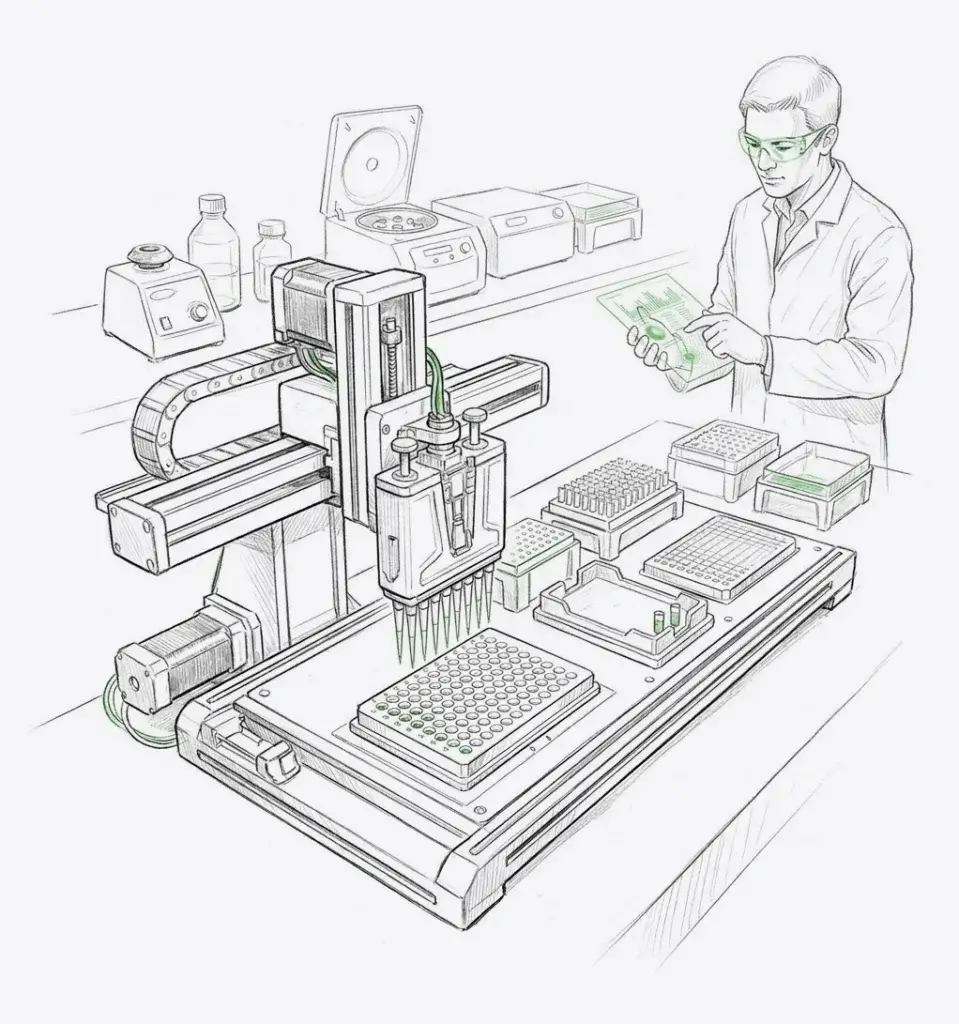
Performing HTP antibody screening in CHO cells from the outset means every data point, including binding kinetics, stability, and aggregation propensity, is generated in the same biological environment used for clinical manufacturing. There is no discontinuity to introduce confounding variables, and no re-verification required when the host stays constant.
Early CHO-based readouts act as a stringent filter, ensuring that only “CHO-healthy” sequences advance into development. Leads that would have failed in manufacturing are eliminated at the cheapest possible stage of the pipeline.
This principle is especially important as AI-driven antibody discovery matures. Modern computational models can generate and down-select thousands of candidate sequences to the best-predicted leads. However, even the most advanced AI models cannot precisely predict affinity, stability, or manufacturability without physical validation.
CHO-native HTP screening provides the clean, manufacturing-relevant data that closes the loop between digital design and physical reality, making it not just a quality safeguard but a strategic input for the next generation of AI-guided discovery programs. This is the foundation of validating AI-designed antibodies with physical data.
CHO cells remain the source of over 70% of approved biologics[2]. CHO-native screening is the only approach that generates data directly predictive of that manufacturing reality from day one.
Your Scientific-Co-Pilot: evitria’s Translatable-Standard
evitria’s High-Throughput Antibody Service is built on a proprietary CHO transient platform, the same expression system used across all downstream scales. This means candidates screened through the HTP workflow can progress toward larger-scale expression without host-system changes, re-optimization, or comparability concerns. The biological continuity this provides is what prevents the Translation Trap from occurring in the first place, delivering the Benefits of High-Throughput Antibody Expression in Early-Stage Discovery without the rework costs of a late host-system switch.
The workflow supports parallel expression of antibody candidates from 24 constructs to several hundred per project. Every project includes a standardized analytical QC package covering titer measurement, HPLC-SEC, CE-SDS, and endotoxin measurement, providing the dataset consistency needed for reliable construct comparison and lead ranking. Standard turnaround is approximately four weeks.
With 15 years of exclusive CHO transient expertise, evitria supports programs from early screening through to higher expression scales and translational material supply, within a single platform and without platform transitions.
Frequently Asked Questions
It is the failure of a drug candidate to maintain its observed discovery-stage properties when moved into preclinical or clinical manufacturing. The most common cause is host-cell switching, where HEK293 is used for screening but CHO is required for manufacturing, introducing biological variables that invalidate early characterization data.
Engineered human lines that attempt to replicate CHO glycosylation exist, but none faithfully reproduce the full complexity of a CHO manufacturing environment, including the specific chaperone network, metabolic profile, and secretory pathway that industrial CHO cells have been optimized around for decades. CHO remains the global standard for over 70% of approved biologics.
The initial transfection step is more technically complex in CHO than in HEK, which may be reflected in upfront costs. However, the total cost of ownership is substantially lower when the cost of host-switch rework later in the pipeline is factored in. Eliminating a single rework cycle more than compensates for any premium in early screening costs.
evitria’s HTP service operates on a standard transient CHO production timeline of approximately four weeks. With 15 years of exclusive CHO transient expertise, the platform is optimized specifically for multi-construct screening campaigns, delivering screening-ready material within timelines fully competitive with HEK-based approaches.
The workflow accommodates a wide range of campaign sizes, from 24 constructs to several hundred per project. Project design is adapted to molecule format, required analytical scope, yield requirements, and turnaround priorities. evitria provides a bespoke proposal based on your specific screening parameters.
Sources
- [1] Tan, E., Chin, C. S. H., Lim, Z. F. S., & Ng, S. K. (2021). HEK293 Cell Line as a Platform to Produce Recombinant Proteins and Viral Vectors. Frontiers in bioengineering and biotechnology, 9, 796991. https://doi.org/10.3389/fbioe.2021.796991
- [2] Dumont, J., Euwart, D., Mei, B., Estes, S., & Kshirsagar, R. (2016). Human cell lines for biopharmaceutical manufacturing: history, status, and future perspectives. Critical reviews in biotechnology, 36(6), 1110-1122. https://doi.org/10.3109/07388551.2015.1084266